How Customer Experience AI Is Changing Customer Service
A single bad support interaction can cost you a customer for good. Nine in ten consumers who have one poor customer service experience say they are likely to avoid that company afterward. That statistic helps explain why customer experience AI (CX AI) has become a board-level priority in such a short period. Customer experience AI refers to the use of artificial intelligence technologies, including machine learning, natural language processing (NLP), Generative AI, Large Language Models (LLMs), and, more recently, Agentic AI to understand, automate, and improve customer interactions across voice, chat, email, and other channels.
For many organisations, the challenge is operational rather than technological. A typical contact centre may be handling growing contact volumes while agents switch between multiple systems to find information, customers repeat details across channels, and queues continue to build. Customer experience AI is designed to address these inefficiencies by giving agents faster access to knowledge, automating routine tasks, surfacing actionable insights, and helping resolve issues before customers need to make contact. This can also support broader contact centre optimisation by improving how people, technology, and customer interactions work together.
The pressure to act is no longer optional. Ninety-one percent of customer service and support leaders say they are under executive pressure to implement AI; not purely for cost savings, but specifically to improve customer satisfaction. And yet the gap between ambition and execution remains wide: only 11% of companies worldwide are using generative AI "at scale," and in a survey of executives at large North American and European firms, just 3% had scaled a single generative AI use case in an operations-related domain such as customer care. That gap between strategic intent and operational reality is where many organisations find themselves today.
Over the following sections, we'll define what customer experience AI actually is, walk through how it works mechanically, explore where it delivers the most value in practice, quantify the business case, break down the main categories of tools available, look at how different industries are applying them, and lay out a practical, step-by-step path to implementation. If you're trying to separate genuine capability from marketing noise, this is the place to start.
What Exactly Is Customer Experience AI and How Does It Work?
Customer experience AI is not a single product. It's an umbrella term covering a range of technologies like conversational AI and AI Agents, generative AI copilots for human agents, AI analytics, customer experience analytics, automated AI knowledge retrieval… that are applied to customer-facing and back-office service operations. It's easy to conflate the category with "chatbots," but a rules-based chatbot that follows a fixed decision tree is a fundamentally different technology from an AI autonomous support agent that can understand open-ended language, retrieve information from a live knowledge base, and generate a novel response. Both fall under the customer experience AI umbrella; neither represents the whole of it.
So how does Customer Experience AI actually function? Most modern systems rely on a combination of natural language understanding (NLU), which parses what a customer or agent is asking, and large language models (LLMs), which generate a coherent response. Rather than inventing answers from general training data alone, well-built systems use a technique called retrieval-augmented generation (RAG): RAG AI Agents can search a company's own knowledge base, policy documents, or CRM records for relevant, up-to-date information, and then uses that retrieved content to ground its response. This is what separates a reliable customer experience AI deployment from one prone to fabricating answers: the quality of the underlying data and retrieval system matters as much as the model itself.
For agent-facing AI Customer Experience tools, the mechanics are similar but the output differs: instead of replying directly to a customer, the AI surfaces a suggested response, a summary of the customer's history, or a next-best-action recommendation, leaving a human agent to review, edit, and send it. This human-in-the-loop design is common but not universal; some customer service software platforms are built for fully autonomous resolution on narrow, well-defined tasks (such as a password reset or an order status check), while others are designed purely to assist humans and never interact with the customer directly.
Implementations of Customer Experiecne vary considerably in how much autonomy they're given, how tightly they integrate with existing systems like CRM and ticketing platforms, and how much human oversight is built in. A business evaluating options should treat these as genuinely different design choices, not interchangeable features.
What is customer experience AI?
What is the difference between customer experience AI and a chatbot?
How can customer experience AI improve contact centre operations?
Can customer experience AI work across voice and digital channels?
Summary
Customer experience AI is a category of technologies, not a single tool, that uses natural language processing and generative AI, usually grounded in a company's own data through retrieval-augmented generation, to automate, assist with, or improve customer-facing and internal service work. Some systems act autonomously on narrow tasks; others exist purely to help human agents work faster and more accurately.

Where Does Customer Experience AI Actually Get Used Day to Day?
Customer Self-Service
The most visible use case of AI Customer Experience tools is self-service: a customer-facing virtual agent that can answer questions, process simple transactions, or triage an issue without waiting for a human agent. This matters because self-service today is underperforming. Gartner's survey of 5,728 customers found that only 14% of customer service issues are fully resolved through self-service channels, and even among issues customers themselves describe as "very simple," only 36% resolve fully, largely because the company didn't understand what the customer was trying to do (45% of cases) or the customer couldn't find relevant content (43% of cases). Generative AI is being applied directly against that failure pattern, using natural language understanding to interpret intent more accurately than older keyword-based systems and RAG to surface the right content on the first attempt.
Agent-Assist
The second major use case sits behind the scenes: agent-assist, or "copilot" AI digital assistant tools that support human agents rather than replacing them. A landmark study using data from 5,179 customer support agents at a Fortune 500 software firm found that a generative AI-based conversational assistant increased agent productivity (measured as issues resolved per hour) by 14% on average, with a 34% improvement among novice and lower-skilled agents specifically. This points to a use case that's often overlooked in the excitement about customer-facing bots: Customer Experience AI's biggest near-term impact may be making newer or less experienced agents perform like veterans, rather than replacing headcount outright.
Proactive Service Based on Analytics
A third use case is predictive and proactive service; using historical and behavioral customer experience analytics data to anticipate a customer's need before they raise it, whether that's flagging a likely delivery delay, predicting churn risk, or routing a customer to the right specialist based on the nature of their issue. Leading companies are 48% more likely to invest heavily in generative AI specifically to improve prediction of customer needs than companies with the weakest service outcomes, though the same research found only 14% of executives overall say their companies regularly use data-generated insights to improve service, suggesting most organizations have not yet operationalized this use case.
Conversation Intelligence
A fourth use case of Customer Experience AI is conversation intelligence and customer experience analytics: mining call transcripts through AI call analytics, chat logs, and support tickets for sentiment, compliance risk, and recurring pain points, then feeding those insights back into training, product, and process decisions. While these capabilities are often spread across separate tools, customer analytics software like ConnexAI brings conversation analytics, AI-powered automation, and customer experience management intelligence together within a single platform, allowing businesses to connect insights directly to the workflows and customer interactions they inform.
Summary
Customer Experience AI is applied across four recurring workflows: self-service deflection, human agent assistance, proactive/predictive outreach, and conversation intelligence, each targeting a different, well-documented operational weak point, from low self-service resolution rates to under-used customer data.
What Measurable Benefits Can You Expect From Customer Experience AI?
Faster resolution and higher agent throughput
The clearest, most rigorously measured benefit comes from the NBER/Quarterly Journal of Economics study cited above: a 14% average increase in issues resolved per hour, rising to 34% for newer agents, alongside reduced average handling time and a 25% drop in requests for managerial intervention. For a contact center running on tight margins, that kind of productivity gain translates directly into either lower staffing costs or higher throughput without adding headcount.
Cost efficiency at scale
McKinsey estimates that applying generative AI to customer care functions could increase productivity at a value equivalent to 30–45% of current customer-operations function costs, driven by improved self-service, faster first-contact resolution, and reduced agent handling time. This is a modelled estimate rather than an average observed outcome, so treat it as a ceiling on the opportunity rather than a guaranteed result for any single deployment.
Closing the self-service gap
With only 14% of issues fully resolved in self-service today, the opportunity for improvement is substantial, and it's a lever many businesses haven't pulled yet. Every percentage point of issues deflected from a human agent to a well-functioning self-service flow reduces both cost per contact and customer wait times simultaneously.
Stronger customer retention
Because 87% of consumers say they're likely to avoid a company after just one bad service experience, the retention value of getting a resolution right the first time is difficult to overstate. Accenture also found that companies leading in generative AI adoption are 82% more likely to use it to help agents resolve issues faster and more effectively than lower-performing peers; a gap that compounds over time as leaders pull further ahead on customer loyalty.
Better employee experience, not just customer experience
It's easy to frame Customer Experience AI purely as a customer-facing or cost-cutting tool, but the evidence points to a real employee benefit too. The same NBER/QJE study found that the AI assistant improved employee retention alongside productivity — plausible given that less-experienced agents, who tend to feel the most stress in the role, saw the largest productivity gains. Separately, McKinsey's research on generative AI's economic potential notes that knowledge workers spend roughly a fifth of their time (about one day per working week) simply searching for and gathering information, a foundational inefficiency that AI-powered knowledge retrieval is designed to reduce.
Sharper personalization and prediction
Companies leading in generative AI adoption are 87% more likely to use it to personalize digital channels than lower-performing peers, turning what used to be manual segmentation work into something closer to real-time, individualized service.
Organizational momentum and investment
This isn't a fringe bet: 75% of service and support leaders report increased AI budgets year over year, and the typical leader plans to add five new full-time roles in the next 12 months specifically to manage AI investments; a sign that the businesses furthest along see AI Customer Experience as a durable operating shift, not a short-term experiment.
What Are the Main Types of Customer Experience AI Tools?
Conversational AI and virtual agents
These are customer-facing systems (chat, voice, or messaging-based) designed to handle conversations with customers directly, from answering FAQs to completing transactions like a return or address change. Conversational AI typically combines natural language understanding (NLU), speech recognition for voice interactions, and large language models (LLMs) to interpret customer intent and generate relevant responses. Traditional virtual agents may rely on predefined rules, decision trees, and scripted responses, while newer systems use LLMs grounded in a business's knowledge base to generate more flexible, context-aware answers. Their advantage is 24/7 availability and the ability to absorb high-volume, repetitive queries.
AI agents take this a step further. Rather than being primarily focused on responding to a customer, an AI agent can reason through a task, decide what actions are needed, access business systems and data, and complete multi-step processes on the customer's behalf. This makes agents more suitable for interactions that require more than retrieving information or following a fixed conversation flow. In more advanced deployments, AI autonomous support agents can handle defined service processes with limited human intervention.
What businesses should use this: organizations with high volumes of predictable, well-documented queries (order status, account questions, basic troubleshooting) where a clear knowledge base already exists to ground the AI's responses. For more complex workflows involving multiple systems, decisions, or actions, an AI agent can extend these capabilities beyond conversation into task completion.
AI voice
These Customer Experience AI tools use AI voice technology to automate and improve voice interactions, combining automatic speech recognition (ASR), AI voice recognition, natural language processing, and AI voice generation to understand and respond to customers in real time. AI Voice Recognition converts spoken language into text so an AI system can interpret what a customer is saying, while voice recognition can help identify speakers and distinguish relevant characteristics of the audio. Voice generation then produces spoken responses that allow the interaction to continue naturally.
An AI phone agent can handle inbound or outbound calls, answer questions, authenticate customers, and complete tasks without requiring a human agent for every interaction. More advanced AI voice agents can also access business systems, retrieve information, and carry out multi-step workflows, extending voice automation beyond simple scripted conversations. These capabilities can operate within existing cloud contact centre solutions or alongside a traditional call center phone system, depending on how the organisation's voice infrastructure is configured.
Unlike text-based conversational AI, voice systems have to handle the additional complexity of spoken communication, including accents, background noise, interruptions, varying speech patterns, and the need to respond with low latency. The advantage is that businesses can automate high-volume phone interactions while retaining a familiar customer channel.
What businesses should use this: organizations with significant call volumes where customers still rely heavily on the phone, particularly for repetitive service, sales, appointment, collections, or verification workflows that can be handled through automated voice interactions.
Agent-assist / copilot tools
These AI Customer Experience tools sit alongside a human agent rather than facing the customer, suggesting responses, summarizing case history, or recommending next actions in real time. The mechanics mirror conversational AI, but the output is a draft or recommendation rather than an automatic send. The advantage, as the NBER/QJE research demonstrates, is a meaningful and measurable productivity lift, particularly for newer staff; the trade-off is that value depends heavily on agent adoption and willingness to use the suggested content rather than working around it.
What businesses should use this: contact centers with high agent turnover or a large share of newer staff, where fast onboarding and consistency matter more than full automation.
Predictive and proactive service AI
This category uses historical and behavioral data (past purchases, support history, product usage patterns) to anticipate an issue or need before the customer raises it, then triggers a proactive outreach or internal alert. It typically relies on machine learning AI Analytics models trained on structured customer data rather than conversational AI alone, often as part of broader customer analytics software or customer interaction management system. The advantage is heading off dissatisfaction before it escalates; the limitation is that it requires clean, integrated customer data to work reliably, which many organizations don't yet have in place.
What businesses should use this: businesses with a well-instrumented customer data platform and a clear, high-value trigger event to act on, such as churn risk or shipment delays.
Conversation and sentiment intelligence
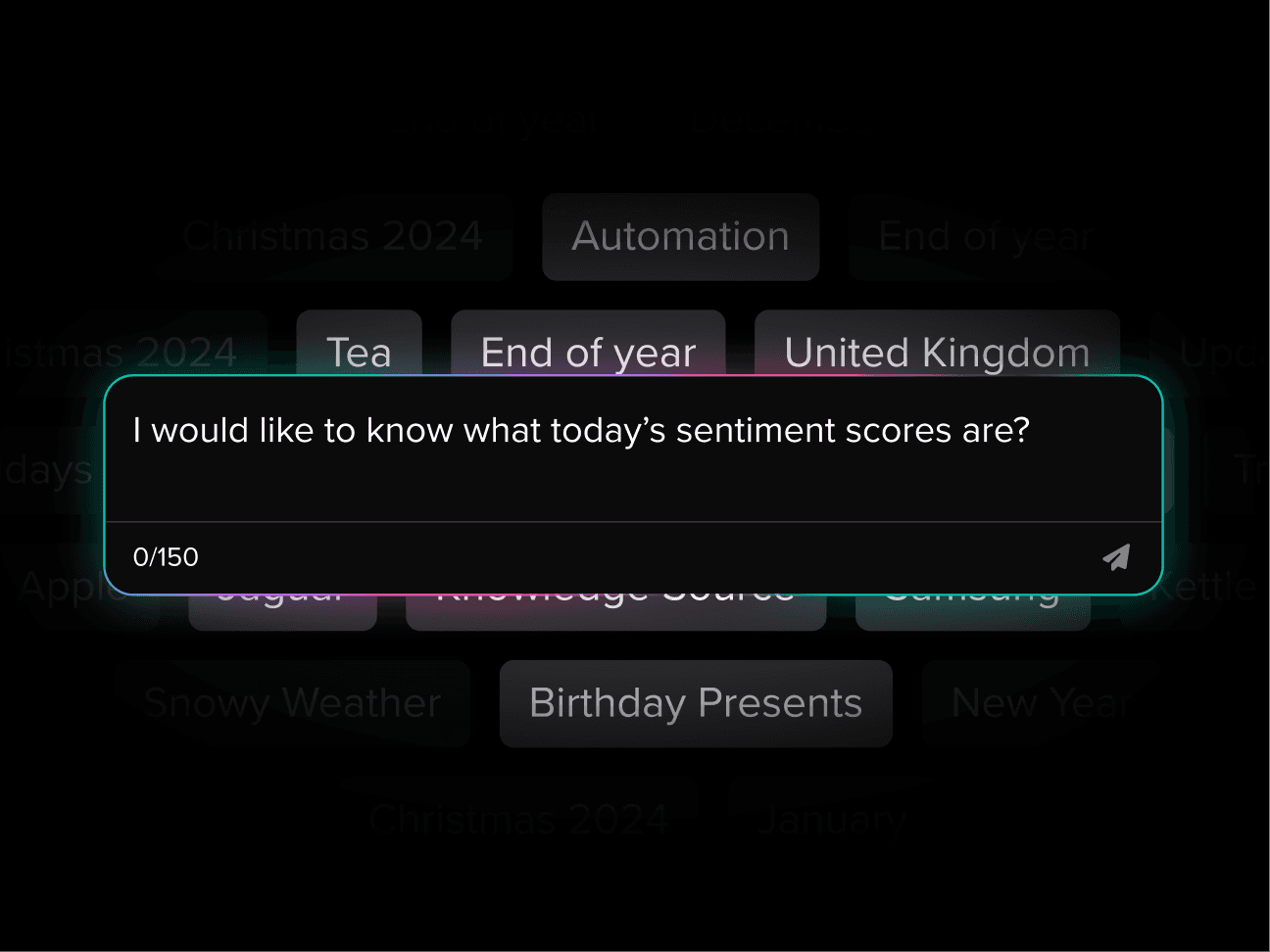
These Customer Experience AI tools analyze completed interactions (calls, chats, tickets) using sentiment analysis, AI call analytics, and customer experience analytics to score sentiment, flag compliance risks, and surface recurring themes for quality assurance and coaching. An AI quality assurance system can apply these models across a much larger proportion of interactions than manual sampling, while a contact center analytics platform can bring the resulting insights together with operational and performance data. Mechanically, this is closer to classification and pattern recognition than generative response. The advantage is visibility into what's actually happening across thousands of interactions that no human could manually review; the limitation is that insight alone doesn't fix anything; it needs to feed into a process that acts on the findings.
What businesses should use this: organizations with a mature quality assurance function looking to scale coaching and compliance monitoring beyond manual call sampling.
Knowledge management and retrieval AI
This is the RAG-based infrastructure that underpins many of the tools above; a system that indexes a company's internal documentation and retrieves the most relevant content in response to a query, whether that query comes from a customer, an agent, or another AI system. Its advantage is accuracy: grounding responses in verified internal content sharply reduces the risk of fabricated answers. Its limitation is that it's only as good as the underlying content; outdated or poorly organized knowledge bases will produce outdated or poorly organized answers.
What businesses should use this: any business deploying conversational or agent-assist AI, since reliable retrieval is close to a prerequisite for trustworthy output, not an optional add-on.
Workforce and operations AI
Less visible to customers but operationally significant, these tools use AI to forecast contact volumes, optimize staff scheduling, and route work intelligently across channels and skill sets. The advantage is smoother operations and fewer instances of over- or under-staffing; the limitation is that forecasting accuracy depends on historical data quality and can struggle with genuinely novel events.
What businesses should use this: larger, multi-channel operations where staffing inefficiency is a material cost driver, rather than small teams with simple, stable volume patterns.
What is the difference between conversational AI and AI agents?
What is an AI phone agent?
Why is knowledge management important for customer experience AI?
What is AI quality assurance in a contact centre?
Which Industries Are Getting the Most Value From Customer Experience AI?
Retail and e-commerce
Retailers face extreme, predictable volume spikes (holiday sales, product launches, flash promotions) that overwhelm fixed-size support teams. Customer experience AI absorbs the surge through self-service order tracking, returns processing, and product Q&A, while agent-assist tools help seasonal or newly hired staff ramp up quickly. A mid-sized online retailer facing a holiday-season ticket spike, for instance, could reasonably expect the kind of agent productivity gains documented in the NBER/QJE research (roughly 14% more issues resolved per hour on average, and closer to a third more among newer seasonal hires) without having to double its temporary headcount.
Financial services and banking
Banks, financial services providers and insurers operate under strict regulatory and compliance requirements, which makes conversation intelligence and accurate, well-grounded knowledge retrieval especially valuable; errors here carry both customer trust and compliance risk. AI-assisted agents can pull the correct, current policy language in real time rather than relying on memory, while sentiment and compliance monitoring tools flag risky conversations for review before they become complaints or regulatory issues.
Telecommunications
Telecom providers deal with high call volumes around billing disputes, service outages, and technical troubleshooting — categories that map closely to Gartner's finding that customers most often fail at self-service because the company doesn't understand their issue or they can't find relevant content. Conversational AI grounded in accurate, current network-status and billing data directly targets that failure mode, while predictive Customer Experience AI tools can proactively notify customers of an outage before they call in to report it.
Travel and hospitality
The travel and hospitality sector experiences highly time-sensitive, often emotionally charged service moments (a cancelled flight, a delayed check-in) where a slow or generic response drives the kind of dissatisfaction Accenture's research links to customer defection. Proactive AI that detects a disruption and reaches out with rebooking options before the customer has to call in addresses this directly; agent-assist tools help human staff resolve the remaining, more complex cases faster during high-stress periods like weather disruptions.
Healthcare and insurance BPO
Business process outsourcers serving healthcare and insurance clients handle high volumes of claims, eligibility, and benefits questions where accuracy is non-negotiable and knowledge changes frequently across different client contracts. Retrieval-grounded AI tools that pull from each client's specific, current policy documentation rather than general knowledge, help reduce the inconsistency risk that comes from agents juggling dozens of overlapping client rulebooks, a scenario a specialized CX AI platform like ConnexAI is often brought in to address given the multi-client complexity involved.

How Should You Actually Implement Customer Experience AI?
1. Audit your current CX data and pain points
Before selecting any tool, map where your existing self-service and agent workflows are actually failing. Use your own ticket data to find the equivalent of Gartner's finding that customers most often struggle because the company didn't understand their issue or they couldn't find relevant content — those two failure modes should shape which use case you tackle first.
2. Align stakeholders and set concrete KPIs
Customer Service AI usually touches operations, IT, compliance, and frontline leadership simultaneously, and misalignment here is one of the most common reasons pilots stall. Set specific, measurable targets up front (resolution rate, handling time, agent productivity, retention) rather than a vague goal of "using AI," so that a pilot's success or failure is clear rather than debatable after the fact.
3. Choose the right tool and channel mix for your problem
Not every business needs every category described above. A high-volume retailer facing repetitive queries may get the fastest return from call center software with self-service conversational AI, while a compliance-heavy financial services firm may see more value starting with agent-assist and knowledge retrieval. A contact center software platform like ConnexAI, which spans several of these categories, can be a practical starting point for organizations that expect to need more than one CX AI capability over time, rather than piecing together several disconnected point solutions.
4. Integrate with your existing systems before going live
The quality of any customer experience AI deployment depends heavily on integration with your CRM, ticketing platform, and knowledge base; a disconnected call center AI tool working from stale or incomplete data will underperform regardless of the underlying model. Budget real implementation time for this step; it's consistently underestimated.
5. Pilot narrowly, test rigorously, and gather direct feedback
Start with a defined subset of queries or a single team rather than a full rollout, and track both quantitative metrics (resolution rate, handling time) and qualitative feedback from the agents and customers actually using it. This mirrors how the productivity gains documented in the NBER/QJE research were identified: through careful, measured comparison against a control group, not assumption.
6. Scale deliberately and keep iterating
Once a pilot demonstrates real results, expand channel by channel or team by team, continuing to monitor performance and retrain or reconfigure the system as your products, policies, and customer needs evolve. Treat this as an ongoing operational discipline rather than a one-time deployment; the organizations pulling furthest ahead, per Gartner's research on rising AI budgets and dedicated new roles, are the ones treating it that way.
Conclusion
Customer experience AI isn't a single tool you buy once and forget: it's a category of technologies, from self-service virtual agents to agent-assist copilots to predictive outreach, each addressing a specific, well-documented weak point in how businesses serve customers today. The data is consistent on one point in particular: the businesses seeing the strongest results are the ones matching the right type of AI to a clearly defined problem, backed by solid underlying data, rather than deploying AI broadly and hoping for the best.
As these systems become more capable, some organisations are moving towards an AI autonomous call handling model for defined voice workflows, while others are building towards a self operating call center in which AI handles selected customer interactions, supports agents, and automates operational tasks across the contact centre. These approaches represent an extension of the same underlying capabilities rather than a replacement for every human-led process.
If you're weighing where to start, the practical path is usually to audit your current pain points, set clear success metrics, and pilot narrowly before scaling. For organizations that expect to need more than one capability over time (self-service today, agent-assist or predictive outreach tomorrow) a Customer Experience AI platform like ConnexAI is built to grow with that roadmap rather than requiring a new vendor for each new use case. A broader call center management platform can provide the infrastructure needed to connect these capabilities as the operation evolves.
If you'd like to talk through where your organization's biggest opportunity lies, book a demo or speak with a ConnexAI representative to see how the platform maps to your specific workflows.