Customer Interaction Analytics: Driving Smarter Decisions and Better Experiences
El análisis de interacción con el cliente utiliza datos de interacciones con los clientes (teléfono, correo electrónico, redes sociales) para mejorar las decisiones y experiencias. Utilizando Inteligencia Artificial y aprendizaje automático, rastrea métricas como la satisfacción del cliente y los tiempos de resolución para identificar tendencias y mejorar el servicio, conduciendo a una mejor toma de decisiones, mayor eficiencia y una mayor retención de clientes.
Conocer qué les importa a los clientes y cómo es para ellos contactar con los representantes de tu marca es vital para la Gestión de Interacción con el Cliente y esencial para el crecimiento del negocio. Los datos muestran que las empresas que priorizan la experiencia del cliente ven beneficios financieros significativos: el 84% de las empresas centradas en mejorar la experiencia del cliente reportan un aumento en los ingresos, aquellas que ofrecen una Experiencia del Cliente sobresaliente generan 5.7 veces más ingresos que sus competidores, y las empresas ven un aumento en la rentabilidad del 25-95% después de solo un 5% de mejora en la retención del cliente.
Para gestionar efectivamente las interacciones con los clientes e identificar áreas de mejora, las empresas pueden aprovechar una gran cantidad de datos para impulsar la toma de decisiones informada. Sin embargo, procesar y analizar grandes volúmenes de datos puede ser un desafío. A medida que tu negocio crece, comprender profundamente los datos del cliente es esencial para el crecimiento y la retención, proporcionando información valiosa para el desarrollo de productos y ofertas dirigidas. Aquí es donde el análisis de interacción con el cliente se vuelve esencial.
En los próximos párrafos, explicaremos todo lo que hay que saber sobre el Análisis de Interacción con el Cliente, desde en qué consiste hasta por qué es tan importante en el contexto actual, así como el papel que desempeña en la Gestión de Interacción con el Cliente y las características o herramientas más importantes que puede incluir.

How Customer Interaction Analytics Elevate Service and Strengthen Brands
Cada interacción con el cliente presenta una oportunidad. Sin embargo, en el panorama actual, el éxito de un negocio no se basa únicamente en aumentar las ventas, realizar ventas adicionales o resolver preocupaciones de los clientes. Se trata también de la experiencia que una marca ofrece a sus clientes. Cada conversación es una oportunidad para crear una experiencia memorable y aumentar la lealtad a la marca, y por eso el análisis de interacciones con clientes es tan importante en cada Sistema de Gestión de Interacciones con Clientes.
El análisis de interacciones se refiere al proceso de transformar datos cualitativos no estructurados de interacciones con clientes en métricas cuantitativas mensurables. Este enfoque permite a las empresas discernir qué estrategias son efectivas y identificar áreas para mejorar.
Cada interacción que un cliente tiene con un negocio, independientemente del canal, puede ser una fuente valiosa de información sobre las operaciones del negocio y la efectividad del servicio al cliente. No obstante, depende de los gerentes y los responsables de decisiones utilizar estos datos para impulsar cambios positivos.
Por ejemplo, una llamada de soporte al cliente ofrece más que solo la resolución de problemas; sirve como fuente de datos que revela problemas comunes de productos o servicios, oportunidades para la capacitación de agentes, y áreas del recorrido del cliente que requieren refinamiento.
Al enfocarse en el análisis de interacciones, las empresas pueden abordar preguntas clave como: ¿Qué expresan, piensan y sienten los clientes? ¿Dónde surgen problemas recurrentes? ¿Están los clientes recibiendo un servicio óptimo? ¿Cómo se puede mejorar la experiencia general del cliente?
El análisis efectivo de interacciones requiere el uso de software de servicio al cliente capaz de comprender el lenguaje humano, monitorear numerosas conversaciones en tiempo real y agregar datos de todos los puntos de contacto.
Pero, ¿cuáles son las herramientas más importantes de software para el análisis de interacciones con clientes y cómo pueden ayudar a su negocio? Veámoslo en la próxima sección.
What is Customer Interaction Analytics and why is it important?
How does AI and machine learning enhance Customer Interaction Analytics?
What types of metrics are tracked with Customer Interaction Analytics?
How can businesses use Customer Interaction Analytics to enhance customer experience?
Summary
Customer Interaction Analytics leverages data from all customer touchpoints—phone, email, social media—to transform qualitative interactions into actionable insights, using AI and machine learning to track metrics like satisfaction, resolution times, and recurring issues. By analysing this data, businesses can identify trends, optimise service, and improve decision-making, ultimately boosting efficiency, retention, and revenue. Effective analytics helps managers understand what customers care about, detect areas for improvement, coach agents, and refine the customer journey, making every interaction an opportunity to enhance experience, loyalty, and business growth.

Customer Interaction Analytics Tools That Boost Efficiency and Satisfaction
Speech-to-Text AI (STT)
In customer interaction analytics, Speech-to-Text (STT) technology converts voice into written text, enabling the detailed analysis of customer service calls, sentiment analysis, keyword spotting, and real-time assistance for agents. This aids in understanding customer concerns, improving service quality, and ensuring compliance. STT technology can contribute enrich data sources and improve customer experience through comprehensive analysis and personalised, natural interactions. By leveraging these technologies, businesses can gain deeper insights into customer needs and behaviors, allowing them to refine their strategies and deliver more targeted solutions. For example, analyzing call transcripts with STT can reveal common issues customers face, helping companies fix problems faster or train agents more effectively.
A reliable Speech-to-Text AI module that captures the subtle nuances of customer conversations is crucial for seamless integration with other Customer Interaction Analytics tools, such as Sentiment Analysis AI or Keyphrase Analysis, which we’ll explore next.
Sentiment Analysis
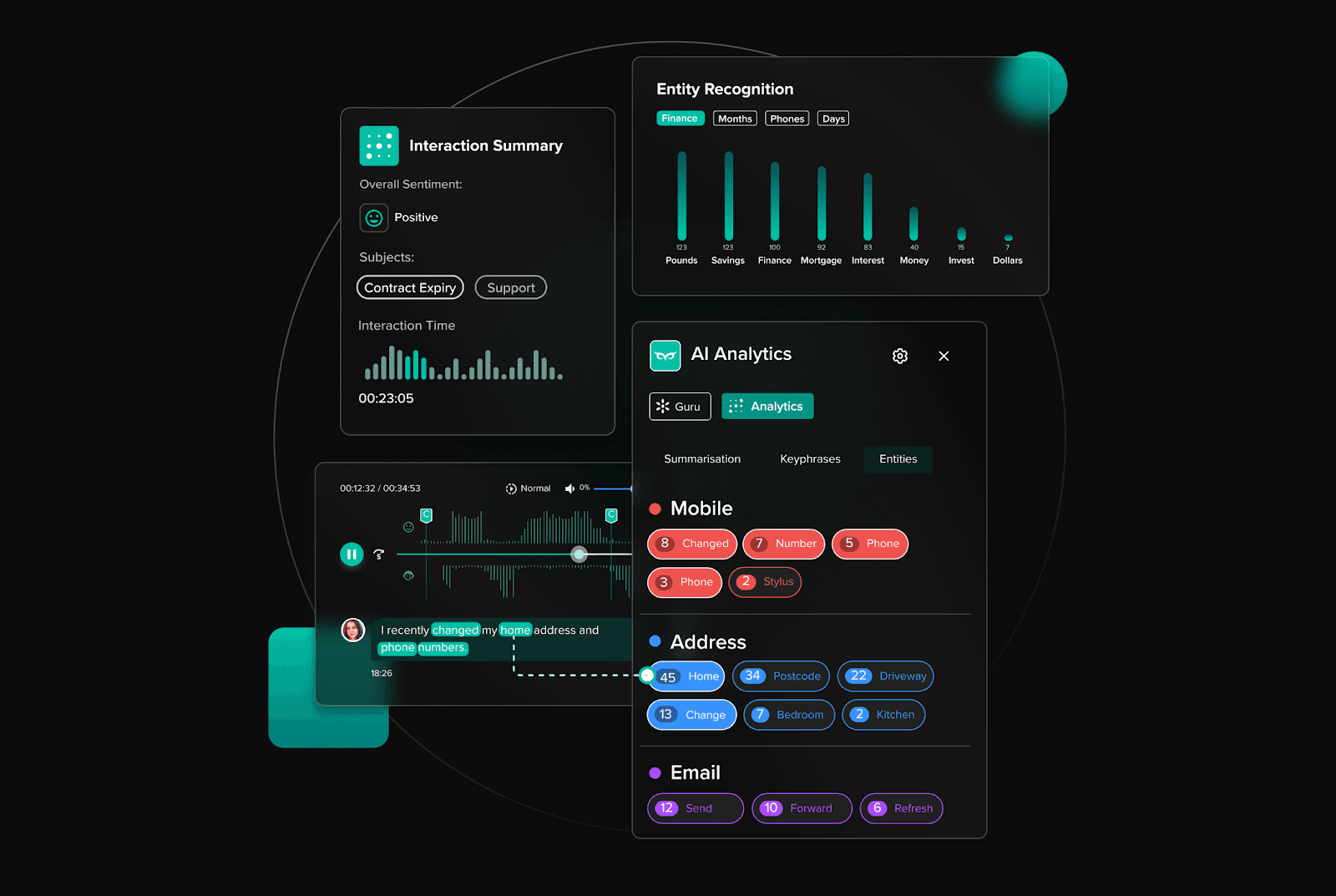
Sentiment analysis is an Artificial Intelligence (AI) tool relying on technologies like NLP (Natural Language Processing) and Speech Analytics that can give a whole new meaning to interactions with customers and help businesses learn more about what their customer engagement teams are doing right and what they’re doing wrong.
Sentiment Analysis provides the capability to assess the sentiment or emotional nuances conveyed by customers during various interactions. Through the meticulous examination of language and contextual cues within customer communications, sentiment analysis distinguishes whether customers convey positivity, neutrality, or negativity towards the brand, its offerings, or services. In essence, it closely examines the emotional tone of customer interactions at each stage of the conversation. By doing so, it provides a deeper understanding of customer concerns, whether they’re satisfied, frustrated, or confused, helping businesses identify pain points. At the same time, it highlights agent performance, revealing how well agents are handling various situations and where they may need improvement. This level of insight not only helps in addressing immediate issues but also in fine-tuning training and strategies to enhance both customer satisfaction and operational efficiency.
This analytical prowess empowers businesses to swiftly pinpoint potential areas of concern or discontent, enabling proactive measures to be implemented to rectify issues before they escalate into significant problems.
Sentiment analysis examines customer interactions to gauge emotions like positivity or negativity, offering insights to improve satisfaction, address issues, and enhance agent performance.
Entity Recognition
Entity Recognition AI is an AI Analytics feature that plays a pivotal role insight gathering by swiftly identifying and categorising specific entities mentioned throughout customer interactions, ranging from company names to product references or prices. This capability significantly enhances data-driven decision-making processes within businesses.
Instead of manually listening to or reading through entire conversations to pull out these details, the AI does it in real-time, allowing businesses to focus on more important tasks. It can tag these key entities, creating a structured data set that can be easily analysed. This not only saves time but also improves accuracy, ensuring that nothing important slips through the cracks.
The real benefit comes when this information is used for decision-making. For example, recognizing frequent mentions of a particular product can highlight trends, or spotting price-related discussions can signal where customers may be having issues. By automatically gathering this data with AI Analytics, businesses can quickly adapt their strategies, improve customer service, and identify areas for improvement—all without the usual delays and resource drain of manual review.
Keyphrase Analysis
Keyphrase analysis tools also use AI to keep tabs on the most commonly used words or phrases in both calls and text conversations, presenting this data in a clear, actionable report for managers and stakeholders. This helps businesses pinpoint common customer concerns, questions, and interests. For example, if a lot of customers are mentioning issues with a product feature, it signals to the company that something might need fixing or improving.
The insights gathered are then turned into straightforward reports that managers can use to make decisions. These reports highlight what customers are most concerned about at any given time, allowing businesses to quickly adapt. For customer service teams, this means they can better anticipate what customers might ask next, address issues proactively, and even tailor interactions to meet customers’ current needs.

By keeping track of these key trends, companies stay one step ahead. They can adjust their offerings, refine their customer service, and ultimately provide a better experience, ensuring they’re not caught off guard by emerging problems or shifting customer preferences. In essence, Keyphrase Analysis unveils what truly matters to customers, empowering contact centres and customer service departments to anticipate market trends and stay ahead of the competition.
Athena AI comes equipped with Keyphrase Analysis, Sentiment Analysis and Entity Recognition features. Moreover, when integrated with Flow, our workflow automation tool, Keyphrase Analysis can identify relevant words and efficiently route calls or communications to the appropriate agent based on required skills, ensuring a smoother customer experience.
Workforce Management Features
Workforce Management Solutions tailored for contact centres and customer service departments serve as a transformative tool, empowering organisations to delve deep into the intricacies of how their agents handle calls. When equipped with AI Quality Assurance features, these specialised Customer Experience Management solutions offer a comprehensive array of features designed to analyse and optimise agent performance during customer interactions.
From real-time call monitoring to detailed performance AI analytics, businesses gain invaluable insights into agent productivity, customer satisfaction levels, and call handling efficiency. By scrutinising metrics such as call duration, resolution rates, and customer feedback, organisations can identify areas for improvement, implement targeted training initiatives, and refine operational strategies to enhance overall service quality.
Ultimately, this enables contact centres and customer service departments to cultivate a more responsive, efficient, and customer-centric approach, driving satisfaction and loyalty while maintaining a competitive edge in today’s dynamic market landscape.
Predictive Analytics
Predictive analytics tools use current and historical data to forecast future events or outcomes, driven by techniques like predictive modeling, machine learning, and Artificial Intelligence. In the context of customer service departments or call centres, these tools analyse data from customer interactions, quality management scores, surveys, Net Promoter Scores (NPS), and text and speech analytics to predict both customer and agent behavior. By identifying patterns, trends, and correlations across this data, predictive analytics provides valuable insights that can help improve operations.
For example, it can predict quality evaluation scores and NPS for all interactions, identify agents who need additional training, and highlight areas where improvements in customer engagement will have the greatest impact. These insights help contact centres optimise their strategies and enhance the overall customer journey.
Another powerful application of predictive analytics in customer interactions is forecasting call volumes. By analyzing historical call data, seasonal trends, and other influencing factors, predictive models can accurately estimate future call volumes. This is especially valuable for anticipating busy periods, such as holiday seasons or product launches, allowing call centres to better prepare. With these insights, businesses can optimise staffing schedules, allocate resources more effectively, and ensure that service levels remain consistent, even during peak times.
Some call centre AI platforms take things a step further by integrating generative AI capabilities. These tools can synthesise information from customer interactions, including common conversation topics, typical dialogue patterns, and key insights, to automatically generate knowledge articles, best-practice guides, and product information, predicting and crafting the best answers for commonly asked questions. This AI-generated content is then seamlessly incorporated into the platform’s knowledge base, creating a comprehensive resource on the company and its products. Agents can leverage this dynamic knowledge by taking advice during conversations from, enabling them to provide faster, more accurate, and more consistent support in future customer interactions.
Omnichannel Customer Journey Analytics
Omnichannel contact centre solutions integrate various communication channels such as texting, calls, emails, and more, providing businesses with a comprehensive view of customer interactions.
By consolidating data from these channels, companies can build detailed customer profiles that capture preferences and behaviours across different touchpoints. This integrated approach allows businesses to map out the entire customer journey, identifying opportunities to improve service delivery and personalise interactions.
Insights derived from omnichannel analytics enable proactive customer engagement strategies, ensuring consistent and efficient communication. Implementing call centre software solutions with Omnichannel features enhances operational efficiency, boosts customer satisfaction, and fosters long-term loyalty by delivering seamless experiences tailored to individual preferences and needs.
How does Speech-to-Text AI (STT) enhance agent performance beyond simple transcription?
Can Sentiment Analysis predict customer behavior and prevent churn?
How can Keyphrase Analysis anticipate customer needs and improve proactive service?
In what ways can Predictive Analytics transform customer interaction strategies?