

Introduction
Healthcare service teams are under intense strain. A typical customer service team handles around 2,000 calls daily but covers only 60% of peak staffing needs, leaving patients waiting an average of 4.4 minutes on hold—far above the recommended 50-second target. The result: 7% of callers abandon before reaching an agent, and nearly a quarter of all patient calls go unanswered. These delays drive real consequences, with 96% of patient complaints citing customer service issues and unhappy patients four times more likely to switch providers.
The financial impact compounds quickly. Routine communication failures fuel no-show rates of 18–27%, contributing to roughly $150 billion in missed appointments annually. Unfilled slots waste billable hours and force staff into extra reminders and callbacks, raising costs while eroding patient retention.
Agentic AI technology offers a way forward. Unlike script-based chatbots, AI Agents can interpret context, take action, and autonomously complete multi-step tasks. They integrate with patient records and scheduling systems, verify insurance, follow up proactively, and deliver fast, personalized resolutions without human intervention. By reducing wait times, lowering costs, and improving patient experience, AI Agents are quickly becoming essential to healthcare customer service.
Understanding AI Agents in Healthcare
AI agents represent a monumental leap forward in patient service. Instead of rigid scripts, they use advanced technology to understand and interpret patient questions in plain, everyday language and then take actions across connected systems. For healthcare, this means integrating with Electronic Health Records (EHRs), appointment systems, billing databases, and communication channels. When a patient initiates contact (phone, web chat, email or SMS), the AI agent:
Understands the query: It uses NLP (Natural Language Processing) technology to interpret the patient’s request.
Accesses records: It securely retrieves the patient’s file from the EHR or practice management system.
Takes action: It executes tasks on behalf of the user (e.g. scheduling, data lookup, document delivery).
Provides answers: It returns a clear, personalized response to the patient, explaining next steps or outcomes.
Follows up: It logs the interaction, updates the record, and can schedule reminders or callbacks if needed.
Implementation in Healthcare
Bringing an AI agent into your healthcare setting doesn't require a complete overhaul of your existing systems. AI suites, like ConnexAI, connect seamlessly using secure, HIPAA-compliant integrations (APIs) to your existing EHR platforms (such as Epic or Cerner) and your scheduling or customer relationship management (CRM) systems.
The process starts with a quick setup where the AI learns your practice's specific language and how your clinic or hospital handles day-to-day operations. Once set up, the AI can immediately begin managing common patient questions across all communication channels, whether they call, chat online, or send a text message. AI Agents can handle routine healthcare tasks like:
Booking or changing appointments
Checking the status of lab results or tests
Processing prescription refill requests
Answering common billing and payment queries
This means your human staff retains control and oversight, stepping in only for complicated matters or when the AI flags an issue for a human handoff. By taking on the high volume of repetitive questions, the AI acts as a 24/7 virtual receptionist and support assistant, freeing up your clinical team to focus entirely on patient care.
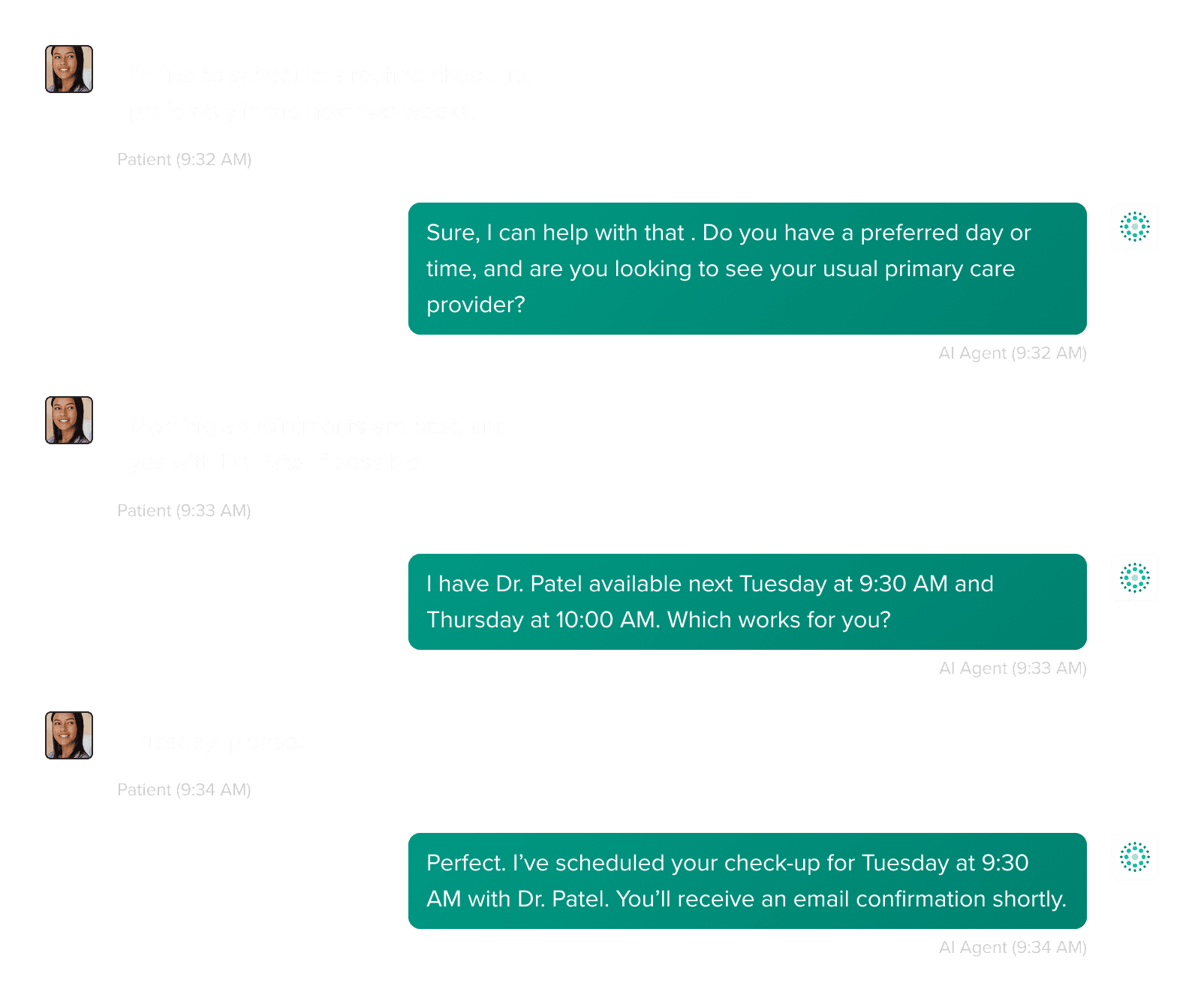
Routine query handling: An example conversation between a patient and a healthcare services AI Agent.
Use Case: Appointment Scheduling
Scenario:
A patient contacts a regional health clinic via the website chat at midnight to schedule a follow-up appointment for next week.
Traditional Process Challenges:
Scheduling typically requires a staff member at a desk during business hours, forcing patients to wait until morning or endure phone queues that often lead to call abandonment. Manually reconciling multiple calendars and verifying patient eligibility is time-consuming and error-prone, especially under high call volumes, creating friction that prevents patients from securing timely care. AI agents eliminate these barriers by providing instant, accurate scheduling support 24/7.
AI Agent Solution – Step-by-Step:
Initial Contact: The patient messages the clinic’s chat portal at midnight, requesting an appointment. The AI agent responds immediately with a greeting, confirming it can assist.
Identity Verification: The agent securely asks for two identifiers (e.g. date of birth and patient ID or last name and address). It verifies these against the EHR to confirm the patient’s record.
Information Retrieval: Once verified, the agent pulls the patient’s history from the EHR: primary doctor, last visit date, and any outstanding referrals or authorizations required.
Calendar Check: The AI agent checks the scheduling system for the patient’s preferred doctor (or next available provider) and finds open slots. It cross-references doctor availability and any pre-appointment requirements (e.g. lab tests needed).
Personalized Response: The agent offers the patient a choice of available appointment times with their preferred practitioner, Dr. Smith, next week and explains any prep steps (e.g. “This appointment is for your routine check-up; remember to bring a list of current medications”).
Additional Support: The agent asks if the patient needs anything else. For example, “Would you like me to send you directions to the clinic or set a reminder?” This covers related tasks (directions, parking info, or an email confirmation).
Completion: Once the patient selects a slot, the AI books the appointment in the system, updates the EHR schedule, and sends a confirmation email/SMS immediately with details and any patient instructions.
Automated Follow-Up: The AI agent records the entire interaction in the CRM. It schedules a reminder 24 hours before the appointment to check if the patient still plans to attend (and can reschedule it if needed). The case is closed unless flagged for human review.
This entire workflow occurs without any human intervention, even outside office hours. The patient gets instant service and skips lengthy customer service queues, and the clinic avoids missed or abandoned contacts.
Beyond Basic Enquiries: Broader AI Agent Capabilities
AI agents offer value across many healthcare processes beyond appointment questions. For example:
Appointment Management: They can book, cancel, or reschedule appointments on demand, send automated reminders, and free staff from manually managing schedules. This 24/7 self-service prevents no-shows and fills vacant slots faster.
Medication and Prescription Queries: Many patient calls involve medication—refills, dosage questions, or possible adverse drug interactions. AI agents can process prescription refill requests by verifying patient details and sending requests to the pharmacy. They can also send medication reminders to ensure adherence, reducing readmissions.
Billing and Insurance Assistance: Over half of patient inquiries center on billing (52%) or insurance (41%). AI agents, integrated with your payment documentation and guidelines, can instantly explain charges, verify insurance coverage, provide payment links or co-pay information, and even assist with prior authorizations, cutting through bureaucratic delays.
Patient Education and Follow-Up: AI can serve as a virtual health educator. After a test or visit, the agent can explain lab results in plain language, deliver discharge instructions, or check on the patient’s status. It can also flag concerning patient answers or feedback for clinician review. By consistently following up on care plans (e.g. scheduling a diabetes check-in or flu shot reminder), AI improves adherence and patient outcomes.
Crucially, Agentic AI operates continuously. During surge periods like flu season or clinic open enrollment, it handles spikes with no extra staffing. Outside normal hours (late nights, weekends), patients no longer hit voicemail or an automated runaround; instead, they get an instant answer. In fact, only 19% of healthcare call centers operate 24/7, yet studies find about 11% of patient calls occur after hours.
AI agents bridge this gap, ensuring patients aren’t left hanging overnight. Meanwhile, your staff can concentrate on complex clinical work, diagnosing illnesses and delivering care, rather than handling repetitive queries. This balance of always-on automation with human expertise raises satisfaction on both sides.
Real-World Impact: A National Healthcare Provider Success
CareGuide, a healthcare cost advocacy service that helps millions of Americans save billions through medical bill negotiation and affordable care navigation, faced a growing challenge: an overwhelming surge of member inquiries about finding low-cost providers, understanding medical bills, and accessing financial assistance programs. To keep service quality high while scaling efficiently, the company turned to ConnexAI's agentic AI technology.
By delegating routine questions to the AI Agent (such as how to find affordable providers, prescription cost assistance, and general billing inquiries), CareGuide was able to redirect its Care Advocates toward what they do best: complex medical bill negotiations, identifying financial assistance opportunities, and securing cost reductions that directly impact member savings.
Results
Cost savings doubled year over year
Data processing capacity rose by 10-12% to support advocate workflows
Missed interactions dropped to zero, improving consistency and trust
AI Agents ultimately enabled CareGuide to operate with greater precision, scale, and compassion—ensuring every member receives timely support while empowering Care Advocates to concentrate on the high-impact work that lowers healthcare costs and protects families from financial hardship.
Onboarding Healthcare AI Solutions
Healthcare organizations gaining a competitive edge today are those deploying AI agents in the foreground of patient service. While others struggle with managing their long hold times and rising costs, forward-thinking providers leverage AI for instant 24/7 assistance and dramatically lower operational overhead. Agentic AI technology addresses a core tension: patient expectations for immediate, always-on care continue to rise, yet healthcare budgets and staffing are stretched thin.
By automating routine communications, AI agents deliver consistent, high-quality responses around the clock, allowing your team to concentrate on tasks that truly need human judgment. For healthcare providers aiming to improve access and satisfaction without ballooning costs or burnout, AI agents are a proven, transformative solution. Embracing agentic AI means fewer missed calls and faster answers today and a scalable, patient-friendly service model for tomorrow.
Getting Started with AI Implementation
Discover how ConnexAI's agentic AI platform can transform inquiry handling for your healthcare services.
FAQs
Do you want to know more about how AI agents can handle patient questions, provide instant information, and reduce the load on your service team? This FAQ answers the key questions on using AI to make every patient interaction faster, smoother, and more reliable.
How does agentic AI differ from traditional healthcare automation tools?
Can AI agents safely handle sensitive patient data without increasing compliance risk?
Will patients trust AI agents with their healthcare needs?
How quickly can a healthcare organization expect ROI?
Can AI agents adapt to each organization's unique workflows and policies?