


Customer Service AI: How Artificial Intelligence Is Reshaping Customer Engagement
Customer Service AI has proven an invaluable resource when it comes to enhancing customer interactions. In recent years, Artificial Intelligence has demonstrated its transformative potential in reshaping business operations across various industries. One area where this impact is particularly pronounced is in customer service. Customer Service AI encompasses contact centre software and technologies that use machine learning, deep learning, NLP, Voice Recognition, and neural networks to perform customer service tasks. As these technologies advance, the scope of Customer Service AI continuously evolves, driven by rapid AI developments and new applications in customer engagement.
But how does customer service AI operate, and what changes can we anticipate in the coming years? And what does this evolution mean for human call centre agents? This article aims to provide insights into these queries and provide you with a comprehensive understanding of why customer service AI is emerging as a transformative force in the customer engagement landscape. Let’s delve into it.
What Is Customer Service AI and How It’s Revolutionizing Customer Engagement
Broadly, Customer Service AI refers to any software or technology, commonly integrated within contact centre software solutions, utilizing Machine or Deep Learning, NLP (Natural Language Processing), ASR (Automatic Speech Recognition), probabilistic forecasting, or neural networks to execute tasks integral to customer service processes.
As these technologies evolve and expand, the definition and scope of Customer Service AI continually transform. The rapid pace of advancements in Artificial Intelligence contributes to the dynamic nature of what falls under the umbrella of Customer Service AI. This evolution persists as AI in the customer engagement field and Call Centre AI discovers new milestones and explores additional potential applications.
The exponential growth of Artificial Intelligence in recent years is expected to persist, leading to the establishment of new functionalities in Customer Service AI. Deloitte’s recent survey indicates a significant 79% of customer service leaders planning substantial investments in expanding their AI capabilities over the next two years. This strategic shift highlights the widespread recognition of Call Centre AI’s potential to revolutionise customer engagement.
In recent years, Customer Service AI has demonstrated its transformative potential in reshaping how companies engage with their customers
The adoption of AI Customer Service software offers a myriad of possibilities for refining customer interactions, with its influence becoming increasingly prominent in shaping how businesses interact with their customer base. This surge in AI adoption signifies an industry-wide acknowledgment that harnessing advanced technologies is crucial for optimising customer experiences and maintaining a competitive edge.
To demonstrate the importance of AI in the customer service landscape, let’s look at some statistics:
30% of customer cases were resolved by AI in 2025. By 2027, that number is expected to go up to 50%, and by 2029, AI Agents are estimated to autonomously resolve 80% of routine customer service issues.
80% of employees report that AI has already elevated the quality of their work. Meanwhile, 79% of customer service agents say that having AI as an assistant significantly boosts their performance, empowering them to deliver a higher level of service.
Compared with consumers who don’t regularly interact with AI agents, those who do report far stronger experiences: customer satisfaction is 46% higher, they are 122% more likely to say AI-powered services have grown more helpful over the past year, 115% more likely to say these services have become more intelligent, and 229% more likely to say they’ve become more proactive.
AI is getting smarter, and customers are noticing. In 2025, 50% of customers resolved issues entirely on their own with AI, up from 32% in 2024; a 51% increase! Even complex inquiries are increasingly handled with confidence: 42% of customers now believe AI can manage them as effectively as humans, up from 28% last year.
Customer support agents who use generative AI assistants are 33% more productive during every hour they work with them.
70% of CX leaders believe AI agents and chatbots are becoming highly skilled architects of personalized customer journeys. The same share say generative AI is making every digital customer interaction more efficient.
Leading companies are 82% more likely to use generative AI to help agents resolve customer issues faster and more effectively.
In the first half of 2025, customer service conversations handled by AI agents grew at an astonishing six-month compound annual growth rate (CAGR) of 2,199% for the average business.
69% percent of service professionals say their organization uses at least one form of AI, including 39% who use agentic AI, 53% who use generative AI, and 44% who use predictive AI.
AI-enabled, trendsetting companies resolve customer service tickets in an average of 32 minutes, compared with up to 36 hours for aspirational companies.
In the second half of 2024, 61% of customer service organisations reported direct revenue growth from generative AI, up from 45% at the start of the year.
Cost reductions followed a similar trend: 45% of organisations saw lower service costs in the first half of 2024, rising to 58% in the second half, an increase of nearly 30%.
In the next section, we’ll take a look at some AI features or applications that can be especially beneficial in the context of customer service. Let’s get to it.
What exactly is Customer Service AI, and how does it differ from traditional customer service software?
Why is the adoption of Customer Service AI accelerating across industries?
How can Customer Service AI improve customer retention and satisfaction?
What challenges do businesses face when implementing Customer Service AI?
Summary
Customer Service AI is rapidly transforming how businesses engage with their customers by leveraging technologies like machine learning, deep learning, natural language processing, automatic speech recognition, and neural networks to perform tasks traditionally handled by human agents. Its scope continues to evolve as AI advances, enabling contact centres to analyse interactions, automate processes, and enhance customer experiences. Widespread adoption reflects its proven impact: AI saves time for professionals, improves satisfaction when combined with human agents, handles more calls efficiently, and contributes to higher retention and lifetime value. With organisations increasingly investing in AI capabilities, Customer Service AI is emerging as a key driver of competitive advantage and a cornerstone of modern customer engagement strategies.

AI Customer Service Tools That Deliver Smarter, Personalized Interactions
1. Conversational AI Bots
Conversational AI bots, one of the most rapidly developing AI Customer Service technologies, are often mistaken for traditional chatbots, with the term “chatbot” frequently used interchangeably for both. However, there is a significant difference between the two.
Traditional chatbots are typically rule-based, meaning they follow predefined scripts and can handle specific tasks or answer questions within the confines of their programming. In contrast, AI Chatbots demonstrate a much higher level of artificial intelligence and natural language understanding. These AI models use advanced machine learning algorithms, such as deep learning, neural networks, and Natural Language Processing (NLP) to generate human-like responses. Unlike rule-based systems, AI chatbots can learn from interactions, adapt to user behavior, and manage more complex conversations. They excel in understanding context, recognizing user intent, and providing more personalized and dynamic responses.
Over the past five years, conversational AI has evolved from simple, rule-based chatbots into sophisticated, context-aware LLMs powered by deep learning and transformer models. Early bots were limited to scripted interactions and keyword matching, but advances around 2019–2020 allowed AI to handle multi-turn dialogues with greater coherence and generate natural responses. More recent developments in generative AI have enhanced these systems’ ability to understand user intent, recognize sentiment, and solve multi-step problems. Modern Call Centre AI platforms can integrate with CRM and backend systems, personalize interactions using historical data, and continuously learn from new interactions, enabling them to resolve queries autonomously and provide richer, more nuanced customer experiences.
This technological progress has shifted customer attitudes and business outcomes. While in 2022 60% of customers said they preferred waiting for a human agent, recent studies show growing trust and preference for AI interactions, with 94% of consumers chose to interact with AI agents when given the option and 60% of them saying that AI agents have become more helpful over the past year. Businesses leveraging conversational AI report higher query resolution, efficiency, and customer satisfaction, with generative AI directly boosting revenue growth significantly in 2024.
Adoption of advanced AI continues to increase, with emerging technologies like agentic AI pushing performance and efficiency even further. AI Agents are autonomous software programs that can independently plan, execute, and adapt to complex tasks, going beyond traditional automation and generative conversational AI, which rely on human direction. In customer service, agentic AI can handle routine and specialized queries, ranging from common support questions to complex insurance, banking, legal, or regulatory issues, while escalating only the most challenging cases to humans.
Modern AI agents, often deployed as chatbots or virtual assistants, integrate with backend systems, improve continuously, and provide insights through Customer Interaction Analytics, helping businesses optimize services and understand client behavior. By autonomously managing most routine interactions and supporting human agents in real time, these systems streamline operations, deliver expert-level personalized support, and enhance efficiency, positioning companies to maintain a competitive edge in knowledge-intensive sectors.
2. ASR IVRs
AI-powered Interactive Voice Response (IVR) systems use technologies like Voice Recognition and Natural Language Processing (NLP) to understand customer queries and provide accurate responses. These systems are a valuable tool for automating customer experiences, allowing customers to interact with businesses through voice commands and eliminating the need for traditional menu-based IVR systems.
By integrating AI, IVRs can intelligently route calls to the most appropriate department or agent, reducing wait times and improving the overall customer experience. Additionally, AI-driven IVRs can efficiently manage routine tasks, such as bill payments or order tracking, without the need for human involvement.
This approach to call center automation optimizes operations, freeing human agents to focus on more complex and high-value interactions. The fast, accurate, and personalized responses provided by AI-powered IVRs significantly enhance customer satisfaction, driving greater loyalty and better business outcomes.
3. Sentiment Analysis
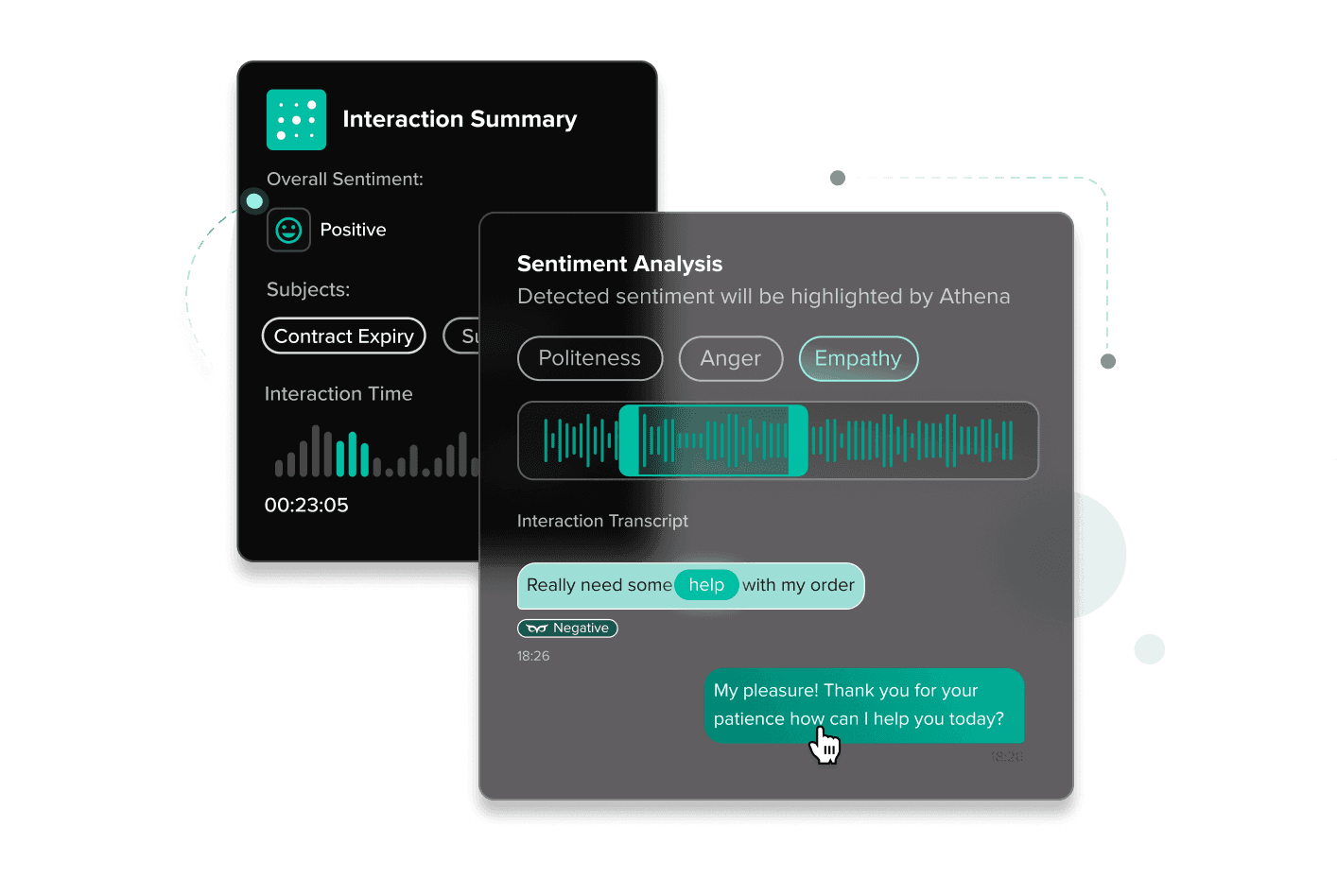
In the context of Call Centre AI or Customer Service AI, Sentiment Analysis is a powerful form of AI Analytics leveraging Speech Analytics. By analyzing factors such as tone, vocabulary, speech rhythm, and inflection, Sentiment Analysis AI can accurately assess the emotional state of callers. This enables AI to track a caller’s sentiment throughout the conversation, providing valuable insights into both the customer’s mood and the performance of the customer service agent. By analyzing customer interactions, sentiment analysis can determine whether customers are expressing positive, neutral, or negative feelings about the brand, products, or services. This enables businesses to swiftly identify areas of concern or dissatisfaction and take proactive steps to resolve issues before they escalate.
Sentiment Analysis technology offers real-time data to customer service departments and contact center managers, allowing them to gain a deeper understanding of their teams’ performance. This information supports targeted coaching to enhance agents’ customer service skills, ultimately leading to improved customer satisfaction and loyalty.
Ultimately, the ability to measure sentiment helps foster a more empathetic and responsive customer service environment, supporting the goal of delivering outstanding customer experiences.
4. Speech-To-Text and Text-To-Speech AI
Speech Analytics and Natural Language Processing (NLP) are two crucial components of Artificial Intelligence that bring immense value to customer service software solutions. Among their most notable applications are Speech-to-Text (STT) and Text-to-Speech (TTS) technologies.
Speech-to-Text (STT) technology converts spoken language into written text, making it essential for call centers. It enables detailed customer interaction analytics, supports sentiment analysis, keyword spotting, and provides real-time assistance to agents. This allows for more accurate identification of customer concerns, enhances service quality, and ensures compliance by tracking conversations and meeting regulatory standards.
Text-to-Speech (TTS) technology converts written text into natural-sounding speech, improving automated customer service in systems like Voice Recognition IVRs, AI Voice Agents, and AI agents. It also enhances accessibility for visually impaired customers, enabling seamless interaction with services.
Together, STT and TTS offer rich data for analysis while enhancing customer experience management through more personalized and natural interactions. They enable call centers to deliver high-quality service, streamline operations, maintain compliance, and address accessibility needs.
5. Customer Interaction Analytics
Speech analytics tools in Customer Service AI tools provide customer interaction analytics capabilities far beyond sentiment analysis. Call Centre AI Analytics and reporting tools offer valuable insights into customer behavior, satisfaction levels, and overall performance metrics. These tools allow businesses to analyze trends, identify patterns, and measure key performance indicators (KPIs) associated with customer interactions.
For example, keyphrase analysis tools track frequently used words and phrases in calls and text interactions. These insights are compiled into detailed reports that give managers and stakeholders valuable information. This data-driven approach helps uncover customer priorities, allowing call centers and customer service departments to proactively identify market trends and stay ahead of competitors.
Additionally, Entity Recognition AI plays a crucial role in identifying specific entities mentioned during calls, such as company names, brands, or products. This real-time detection helps businesses quickly assess the frequency of these mentions. The data gathered enables businesses to evaluate the relevance of these entities and categorize them for future reporting. By capturing, categorizing, and reporting each instance an entity is referenced, Entity Recognition AI enhances data-driven decision-making within call centers.
6. AI Coaching
AI coaching or copiloting tools use advanced analytics and Generative AI to monitor customer interactions in real time, offering instant feedback and practical guidance to customer service agents. By tracking key metrics and analyzing conversation patterns, these tools highlight opportunities for improvement—whether in tone, language choice, or adherence to company protocols. This constant stream of feedback helps agents refine their communication, deepen their product knowledge, and strengthen their problem-solving skills directly within their day-to-day work.
Real-time insights enable agents to adjust their approach on the spot, resulting in more effective and satisfying customer exchanges. As these improvements compound, teams become more skilled, confident, and capable of handling a broader range of inquiries and challenges. In turn, businesses benefit from consistently higher-quality service, stronger customer relationships, and increased satisfaction, loyalty, and retention.
Notably, according to studies by Zendesk, 93% of CX Trendsetters believe AI copiloting is an effective way to help both customers and agents grow comfortable with AI and adopt more advanced capabilities. Agents supported by AI copilots are also 20% more likely to feel empowered to perform their jobs well.
7. Predictive Analytics and Forecasting
Customer Service AI predictive analytics harnesses customer data to forecast call volumes, identify seasonal trends, and anticipate customer behavior patterns. By analyzing historical data, companies can predict when spikes in call volume are likely to occur, allowing for proactive management of customer demand.
For instance, if a surge in calls is anticipated due to a seasonal promotion, businesses can adjust staffing levels to ensure adequate coverage, reducing wait times and enhancing customer satisfaction. Predictive analytics also helps identify potential issues by recognizing patterns in customer complaints, enabling companies to address concerns before they escalate.
Additionally, understanding customer preferences allows businesses to personalize interactions, ensuring agents are prepared with relevant information. In summary, AI-driven predictive analytics enhances resource allocation, improves customer service, and fosters greater customer satisfaction and loyalty.
8. Intelligent Workflow Automation
Intelligent Workflow Automation features included in some AI Customer Service software solutions play a key role in enhancing efficiency and productivity during customer interactions. Customer Experience Automation leads to smoother, more satisfying, and effective engagements, creating memorable brand experiences and boosting customer loyalty.
Customer service automation features streamlines and standardizes processes related to customer interactions. Workflow automation tools can automatically assign incoming inquiries to the most suitable agent based on criteria such as skillset, language proficiency, or availability. This ensures customers are quickly connected to the right person, minimizing wait times and improving service quality.
ConnexAI’s Flow is an example of intelligent workflow automation with a user-friendly drag-and-drop interface. Flow, a cutting-edge Customer Service Automation software tool, allows users to design personalized workflows with endless detail, automate processes, and integrate AI features. This enables conversational AI to handle routine queries, route interactions based on skill, topic, language, or availability, and utilize Text-to-Speech/Speech-to-Text technology.
How do AI Agents differ from traditional chatbots or basic conversational AI?
How do AI Agents acquire domain-specific knowledge?
Can AI coaching personalize learning for individual agents?
How does intelligent workflow automation improve call handling?

Key Benefits of AI Customer Service in Call Centres
Revenue Growth
Implementing AI-driven customer service is rapidly transforming the way businesses grow revenue by boosting both efficiency and customer satisfaction. AI chatbots and virtual assistants provide instant, 24/7 support, dramatically reducing response times and freeing human agents to focus on complex issues. This improved responsiveness not only enhances customer retention but also encourages repeat purchases and often increases average order values.
Beyond faster service, AI Analytics features can examine customer interactions to identify upsell and cross-sell opportunities, personalise recommendations, and anticipate needs, creating a seamless and engaging shopping experience. Over time, these improvements lower operational costs while driving measurable increases in sales and long-term revenue.
The impact of AI adoption is already visible in recent figures. Research from McKinsey shows that in the first half of 2024, only 3% of customer service organizations reported revenue growth of more than 10% directly attributed to generative AI. By the second half, that number had jumped sixfold to 18%. Meanwhile, 14% of organizations sustained growth between 6% and 10%, and 31% reported gains of up to 5% linked to AI. Overall, 61% of customer service organizations saw direct revenue growth from generative AI in the latter half of 2024, up from 45% at the start of the year. Impressively, two out of three business leaders say AI adoption has boosted their revenue growth rate by more than 25%.
Cost Savings
One of the most compelling advantages of Call Centre AI is its potential for substantial cost reduction. By leveraging technologies such as Conversational AI Agents, organizations can automate high volumes of routine customer queries, allowing human staff to focus on more complex and value-added interactions. This not only streamlines operations but also improves overall service efficiency.
A study from McKinsey reveals that cost savings from generative AI accelerated rapidly across customer service teams in 2024. In the first half of the year, 45% of organizations reported lower service-delivery costs; by the second half, that figure had climbed to 58%; a surge of nearly 30% in just a few months. The depth of those savings also increased. By late 2024, 18% of customer service organizations seeing reductions said generative AI was cutting their costs by more than 10%. And the biggest gains became more common too: the share reporting cost reductions above 20% rose from 4% to 7% over the year, almost doubling in six months.
These trends are expected to continue. Gartner projects that Conversational AI alone could reduce agent labor costs by a staggering $80 billion globally by 2026, underscoring the transformative impact of AI on the economics of customer service.
Enhanced Employee Engagement
Customer Service AI is transforming the customer service landscape by enhancing employee engagement and job satisfaction. Advanced forecasting capabilities allow Artificial Intelligence to predict fluctuations in call volume, enabling proactive agent scheduling, ensuring service levels are met, and reducing on-the-job pressure. Beyond planning, AI provides actionable insights for faster issue resolution and more effective upselling, leveraging proven scripts to drive revenue growth.
The impact on employees is clear: 81% of service representatives report that AI makes them more productive, 80% say it reduces stress, and 79% feel it improves their overall job satisfaction. Research from Deloitte shows that organisations using Generative AI are 35% less likely to have agents overwhelmed by the information presented during calls.
AI also appears to support career development. Data from Salesforce shows that in companies with AI agents, 89% of representatives feel positive about their career advancement opportunities—compared to 66% in organizations without AI, a striking 34% difference. Furthermore, 82% of service representatives report acquiring new skills through working with AI, and 67% say it opens doors for career growth (Salesforce, 2025).
In short, Customer Service AI not only optimizes operations but also empowers employees, creating a more productive, satisfying, and growth-oriented work environment in the call centre sector
Deeper Customer Understanding
Improving the customer experience is paramount, and Customer Service AI proves invaluable in achieving this goal. Using features like Natural Language Processing (NLP) and speech analytics, AI records and transcribes customer interactions for easy review.
Transcriptions facilitate quick assessments, enabling supervisors to identify coaching areas and capture essential details. Other AI tools, such as Keyphrase Analysis and Entity Recognition, enhance contact centre analytics, unveiling trends in large customer datasets and providing insights into customer emotions for improved interaction strategies.
Sentiment Analysis stands out as a crucial AI tool, accurately assessing caller emotions through tone, vocabulary, and speech analysis. This capability empowers contact centre managers to offer targeted coaching for enhanced customer service skills. With AI-collected and analysed customer data, businesses can elevate customer satisfaction and evaluate campaign effectiveness.
Elevated Customer Experience
Artificial intelligence is increasingly central to delivering exceptional customer experiences. By providing timely, personalized information, analyzing conversations at scale, and supporting call deflection strategies, AI enables companies to resolve issues more efficiently and anticipate customer needs. Effective call deflection—driven by robust data collection and analysis—enhances satisfaction by guiding customers toward faster, more convenient service through alternative channels.
Consumers are increasingly embracing AI in their interactions. According to Zendesk, 67% of consumers are eager to delegate tasks such as handling customer service issues to a personal AI assistant. More than two-thirds are more likely to engage with and trust AI agents that demonstrate human-like qualities such as empathy, creativity, and friendliness. Additionally, 51% of consumers prefer interacting with bots over humans when seeking immediate service, while 67% are expanding the range of inquiries they pose to AI, asking more varied and complex questions than ever before.
The impact of AI on customer experience is measurable. Compared with consumers who do not regularly engage with AI agents, those who do report significantly stronger experiences: 46% higher overall satisfaction, 122% more likely to perceive AI-powered services as increasingly helpful, 115% more likely to view these services as increasingly intelligent, and an astonishing 229% more likely to recognize their proactive capabilities.
With these capabilities, AI is shaping the future of customer interactions, making service faster, smarter, and more responsive to individual needs.
How does AI support agents in achieving better performance?
How does Sentiment Analysis enhance customer understanding?
How does AI improve first-call resolution rates?
What is required for AI to handle more complex self-service tasks?
How AI revolutionised customer engagement for Old Mutual
Old Mutual is a key player in the South African insurance industry. With customer engagement across multiple channels and a growing need to deliver consistent, personalised service, Old Mutual wanted to transform how it interacted with customers. Automating quality assurance and scaling customer interactions without increasing costs were also key priorities.
After facing challenges with fragmented channels and inefficient processes, Old Mutual underwent a significant transformation following the implementation of ConnexAI’s AI-powered customer service platform. Features such as AI Agent, AI Analytics, AI Quality, and AI Voice brought significant enhancements to Old Mutual’s operations. These advanced tools streamlined customer interactions, improved visibility across channels, and enabled Old Mutual to scale its customer engagement more efficiently.
By bringing AI-powered automation and analytics together, ConnexAI helped Old Mutual eliminate inefficiencies caused by disconnected systems, while enabling its teams to focus on more complex and valuable conversations. AI Agents increased customer contacts without escalating costs, while AI Analytics and automated quality assurance provided 100% interaction coverage and identified areas for improvement. AI Voice further supported personalised customer interactions and improved the overall customer experience.
These capabilities have helped Old Mutual create a more connected, efficient, and scalable approach to customer engagement, supporting its continued innovation in the insurance industry.
If you want to learn more about how ConnexAI’s AI-powered customer service platform helped Old Mutual, watch the video below.
The Future of Customer Service AI and the Role of the Human Agent: Balancing Automation and Human Touch
As we have already noted, the Customer Service AI market is poised for continued growth as the technology advances and more customer engagement teams and contact centers embrace AI to enhance efficiency and maintain a competitive edge. Coming back to the statistics we mentioned earlier, 30% of customer cases were resolved by AI in 2025, by 2027 that number is expected to go up to 50%, and by 2029, AI Agents are estimated to autonomously resolve 80% of routine customer service issues. But can we be sure that Customer Service AI will continue to expand at this exponential rate?
A natural objection to this speculation would be the question of whether AI’s growth will maintain the rapid pace seen over the past 3 or 4 years, or if it will eventually slow down or reach a plateau. Another form of asking this question in more practical terms would be: What if AI has only demonstrated the ability to automate simple, routine interactions—the low-hanging fruit—but struggles to handle more complex interactions, or at least it takes much longer to develop to a stage where it can confidently and reliably master those types of conversations?
Naturally, this will vary by industry. In sectors like retail, for instance, a high volume of queries are likely to be simple or routine, such as questions about order status. Questions in e-commerce, such as “Where is my order?” or “How do I return a product?” and in banking, like “What’s my account balance?” or “How do I reset my PIN?” are common examples of routine customer queries that can easily be handled by chatbots. These simple inquiries, prevalent across many industries, are ideal for automation, as AI Customer Service chatbots can respond quickly and efficiently.
However, a 2022 report reveals that 73% of customer queries across industries can be resolved in five messages or fewer, and research by McKinsey also suggests that around 70% of customer queries are simple or routine enough that they can be easily automated with a customer service AI solution. As Conversational AI keeps developing, it can be reasonably expected that it will become more and more capable of not only addressing more customer queries autonomously, but also to facilitate quicker human responses to those questions that require a higher level of human qualities, like advanced problem-solving, emotional sensitivity (such as handling complaints or disputes), and escalation to specialized teams are essential for addressing more complex customer service issues that require deeper expertise or personalized attention. This continuous feedback enhances agent skills, allowing them to resolve issues faster, build stronger relationships, and increase customer loyalty, ultimately making their jobs easier by automating routine tasks and supporting more complex resolutions.
Will AI eventually replace human customer service agents entirely?
How might AI reshape the role of customer service agents in the future?
How can AI improve the quality of human-led customer interactions?
How can companies measure ROI from implementing Customer Service AI?