Why Your Contact Centre Can't Afford to Ignore AI Voice Agents
The contact centre is under more operational pressure than ever, and managing that pressure by adding headcount is becoming increasingly difficult. Call volumes are rising, agent attrition remains high, talent is harder to retain, and customer expectations for fast, accurate service continue to increase. AI voice agents are software systems that engage in spoken, real-time dialogue with customers by combining automatic speech recognition (ASR), natural language processing, neural text-to-speech engines, and contextual response generation. They are emerging as a powerful way for businesses to manage this pressure without simply hiring more people.
The scale of demand is stark. According to McKinsey's Where Is Customer Care in 2024? report, 57% of customer care leaders expect call volumes to increase by up to 20% in the near term, while talent shortages and attrition remain major operational challenges. At the same time, labour costs account for up to 95% of total contact centre expenditure, making it difficult to absorb volume growth through staffing alone.
The consequence is a widening performance gap that organisations are increasingly addressing through automation. A December 2024 survey by Gartner found that 85% of customer service leaders planned to explore or pilot customer-facing conversational AI in 2025, with more than 75% reporting direct pressure from executive leadership to act. AI voice agents are therefore moving beyond experimental customer experience AI use cases and being assessed as increasingly important operational infrastructure.
What makes AI voice agents valuable, rather than chatbot-based customer service automation or robotic process automation alone, is their ability to meet customers in the voice channel they still use for complex or sensitive enquiries. Built on modern large language model architecture, these systems can recognise intent, handle interruption, maintain conversational context, and escalate appropriately in real time and at scale.
This article covers everything you need to understand AI phone agents as a business decision: how they work, the benefits they can deliver, different deployment types, the technologies that improve their performance, where they fall short, and how to implement them effectively. Whether you are evaluating your first deployment of contact centre agentic AI or looking to move from pilot to scale, this is a practical, evidence-based guide to a significant infrastructure decision for contact centre leaders.
What Exactly Is an AI Voice Agent and How Does It Work?
What Is an AI Voice Agent?
The term “AI voice agent” is sometimes used interchangeably with IVR, voicebot, or virtual assistant, but these are distinct technologies. Understanding the difference matters when evaluating the capability, cost, and business value of a call centre software solution.
A traditional IVR is a menu-driven system that recognises DTMF key presses or simple voice commands mapped to predefined options. A voicebot adds speech recognition but may still rely on limited intents and scripted paths.
An AI voice agent is an agentic AI system that conducts spoken conversations and can understand requests, reason about what needs to happen, and take actions on the caller’s behalf. It uses automatic speech recognition (ASR) to interpret speech, large language models (LLMs) to understand context and determine appropriate responses or actions, and neural text-to-speech (TTS) engines to communicate naturally.
The agentic element is what distinguishes an AI voice agent from a conventional voicebot. It can maintain context, reason through a request, consult business systems and live knowledge sources, and use a RAG AI Agent approach to retrieve relevant information before responding or acting. It can then complete multi-step tasks within predefined guardrails, such as querying a CRM, updating a booking, initiating a payment, or escalating an interaction according to business rules.
How Does an AI Voice Agent Work?
The basic operational loop is straightforward:
Speech recognition: The customer speaks, and an AI Voice Recognition model uses Automatic Speech Recognition to transcribe and interpret the input.
Understanding and decision-making: The AI Voice system identifies intent, considers the conversation and available context, and determines the appropriate response or next action.
Response generation: An LLM or other language model generates a response, while agentic AI can decide which systems or tools to use and execute multi-step workflows.
Speech generation: AI Voice generation, typically through a Neural Text-To-Speech engine, converts the response into natural-sounding speech for the customer.
In agent-assist deployments, these capabilities support human agents in real time. In autonomous deployments, an AI virtual phone agent can manage the interaction independently within defined governance and compliance boundaries.
What Determines AI Voice Agent Performance?
The quality of the experience depends heavily on the underlying technology. The accuracy of ASR solutions, the sophistication of the language and reasoning layers, and the quality of the knowledge sources all affect how reliably an AI system can handle accents, background noise, ambiguous requests, and industry-specific terminology.
Some call centre AI solutions remain largely scripted, while others combine foundation models with retrieval-augmented generation or RAG AI Agents to access live information and handle less predictable conversations.
ASR Accuracy
ASR accuracy is particularly important because every subsequent stage depends on correctly interpreting what the customer said. ConnexAI’s real-time speech recognition benchmark evaluated leading ASR providers including ConnexAI, Google, Amazon, OpenAI, Deepgram, AssemblyAI and Speechmatics across 25 hours of real-world contact centre audio and 16,311 recordings. The study reported a median Word Error Rate (WER) of 7.7% for ConnexAI’s ASR, compared with 10.5% for the next-best provider, across the tested telephony conditions.
Context, Knowledge and Adaptability
AI voice agents also face challenges that text-based conversational AI does not, including background noise, regional accents, overlapping speech, homophones, interruptions, and mid-sentence corrections.
Effective AI Voice technology therefore needs to combine accurate speech recognition with contextual understanding, domain knowledge, and the ability to adapt as the conversation develops. The quality and freshness of the underlying knowledge sources also influence how reliably an agent can respond, particularly when handling less predictable or industry-specific requests.
What is an AI voice agent?
How does an AI voice agent work?
What is the difference between an AI voice agent and an IVR?
What is the difference between agentic AI and other voice AI?
Summary
An AI voice agent conducts real-time spoken conversations by combining speech recognition, natural language understanding, dialogue management, and speech synthesis. Unlike traditional IVR or basic voicebots, it can understand unstructured language, maintain context, and support autonomous resolution or human agents.
What Do AI Voice Agents Actually Deliver for Your Business?
The case for AI voice agents is not theoretical. There is a growing body of operational data from customer service AI deployments at scale, and the measurable outcomes fall into several distinct categories. Here is what the evidence shows.
Faster Resolution and Reduced Handling Time
McKinsey's analysis of a landmark study of 5,000 customer service agents using a generative AI assistant found a 14% increase in the number of customer issues resolved per hour, alongside a 9% reduction in average handle time. These are not headline projections; they are observed outcomes from live AI autonomous call handling deployments. The implication is significant: without adding a single agent, your contact centre can effectively increase its throughput by more than one in ten calls.
Elimination of Wait Times for a Material Share of Contacts
One of the clearest operational benefits of a well-deployed voice AI agent is its ability to handle routine contacts without requiring a human agent to take the call. RefiJet, a US auto refinancing company handling more than 1,000 calls a day, reported that its customer service representatives were taking 50–60% fewer phone calls after deploying ConnexAI’s AI Agent. This reduced the manual effort involved in routine enquiries while allowing its human team to focus on higher-value interactions.
Significant Productivity Gains Across the Customer Care Function
At a function-wide level, McKinsey estimates that applying generative AI across customer care (including voice, chat, and back-office operations) can deliver productivity gains equivalent to 30–45% of current function costs. That figure encompasses reduced handling times, lower repeat contact rates, and improved first-contact resolution, all of which compound over time as AI autonomous support agents are refined.
Substantial Labour Cost Reduction
Gartner projected in 2022 that conversational AI would reduce contact centre agent labour costs by $80 billion globally by 2026; a figure that remains the most widely cited authoritative estimate on the aggregate financial impact of AI voice automation. As organisations move towards the self operating call center model, AI voice agents are becoming a foundational technology for automating routine interactions while allowing human agents to focus on more complex work. Given that labour represents up to 95% of total contact centre expenditure, even a modest automation rate creates outsized financial returns.
Improved Accuracy and Consistency
Unlike human agents, who vary in knowledge, attentiveness, and compliance adherence across shifts, AI voice agents deliver the same answer to the same question every time, provided they are correctly configured and maintained. This consistency directly reduces compliance risk in regulated industries, where an incorrect or non-compliant verbal statement can have legal consequences, and it improves quality assurance at scale without requiring proportionate investment in monitoring.
Reduced Agent Cognitive Load and Improved Employee Experience
Agent burnout is a real and costly problem. Research attributable to Deloitte suggests that companies using generative AI are 35% less likely to report that human agents feel overwhelmed by the volume of information they need to access during customer calls. AI voice agents and real-time agent-assist tools surface the right information at the right moment, allowing agents to focus on the customer rather than searching for answers. The result is not only a better customer experience; it is a better working environment for the people delivering it.
Which Type of AI Voice Agent Is Right for Your Operation?
Voice AI agents are not a single technology. The category includes several deployment types and architectures, each suited to different use cases, volumes, and operational contexts. Understanding these distinctions helps match the right capability to the problem.
Fully Autonomous Inbound Voice Agents
What they are: AI voice agents that handle inbound calls end-to-end, from greeting and authentication to resolution, with human escalation when needed. Modern Customer Experience AI agentic systems can use context, connected data and business tools to handle complex requests beyond scripted FAQs.
How they work: The system uses ASR solutions, AI Voice Recognition and NLU to understand callers, maintain context, retrieve information from CRM and billing systems, and take actions. It can complete multi-step requests autonomously or escalate with relevant context.
Advantages and limitations: Autonomous AI Voice Agents can handle follow-up questions, combine information across systems and complete multiple actions in one conversation. Human escalation remains important for cases requiring judgement, sensitive decisions or actions beyond the agent's capabilities.
What businesses should use this type? Operations with high inbound volumes and complex queries, particularly across utilities, retail, e-commerce and insurance.
Outbound AI Voice Agents
What they are: AI voice agents that initiate calls, often integrated with an intelligent AI dialer or automatic dialer, to automate proactive outreach such as appointment reminders, debt collection, surveys, renewals and service notifications.
How they work: The agent calls at a scheduled time, uses the customer record to personalise the interaction, and conducts a goal-directed conversation with defined resolution and escalation logic if the AI voice assistant cannot handle the request.
Advantages and limitations: Outbound agents reduce the cost of proactive communication at scale and can operate beyond human calling hours. Regulatory compliance is the key limitation, with consent and call timing requirements varying by jurisdiction.
What businesses should use this type? Healthcare providers, financial services firms, and businesses requiring regular proactive outreach. Legal review should precede deployment.
Real-Time Agent Assist
What they are: AI systems that listen during live human-agent calls and surface guidance such as suggested responses, knowledge articles, compliance prompts and next-best actions.
How they work: Automatic Speech Recognition transcribes the conversation in real time. NLU identifies intent and entities, matches the dialogue to knowledge or decision rules, and surfaces relevant content in the agent interface.
Advantages and limitations: Agent assist preserves the human relationship while improving accuracy and reducing handle time. The Deloitte research cited earlier on reduced information overload is most directly applicable to this deployment type. Its value depends on agents actively using the guidance.
What businesses should use this type? Organisations with complex or changing knowledge bases, regulated operations, or inconsistent agent quality. It can also be a suitable starting point before customer-facing automation.
Conversational IVR Replacement
What they are: AI voice agents that replace touch-tone IVR menus with natural language, allowing callers to explain why they are calling rather than navigating menu options.
How they work: The caller responds to an open-ended prompt; their speech is transcribed and interpreted, then either resolved by the AI call answering service or routed to the appropriate human team.
Advantages and limitations: This reduces the friction of traditional IVR and can improve routing. Its main limitation is that it is better suited to triage and routing than full resolution, making it a sophisticated front door rather than a complete solution.
What businesses should use this type? Businesses with legacy IVRs, misrouting, high IVR abandonment or poor initial call experiences. This AI call answering service can be a low-risk entry point into AI voice.
Voice Biometrics and Automated Authentication
What they are: AI voice systems that authenticate callers using their voice, replacing security questions, account numbers or PINs.
How they work: The system creates a voiceprint during enrolment, then compares the caller's live voice against it during subsequent calls to confirm or flag authentication.
Advantages and limitations: Automating authentication can reduce handle time and customer friction. Accuracy can be affected by illness, environment or impersonation attempts, while privacy and data protection require careful legal review.
What businesses should use this type? Financial services, insurance, and telecommunications businesses with high call volumes and repetitive authentication requirements, as well as organisations seeking to reduce fraud risk.
What Technologies Amplify the Value of an AI Voice Agent?
An AI voice agent deployed in isolation will deliver measurable value. But the businesses that see the most significant returns are those that integrate their voice agents into a broader technology ecosystem. Here are the integrations and complementary capabilities that most consistently amplify performance.
CRM Integration
The gap between a generic AI phone agent and one that delivers a personalised, contextually intelligent experience is almost always a CRM integration. When an AI voice agent can access the customer's account history, recent interactions, open cases, and stated preferences in real time, it can personalise the conversation from the first second: greeting the caller by name, referencing their last interaction, and anticipating the reason for their call based on recent account activity.
The practical result is a material reduction in time spent establishing context. The customer does not need to re-explain who they are or repeat information they have given before (one of the most persistent drivers of poor customer satisfaction scores). ConnexAI's Customer Experience AI platform, for example, integrates natively with leading CRM systems, enabling AI voice agents to surface and update customer records in real time during a conversation, so that the information an agent or automation retrieves reflects the actual current state of that customer relationship rather than a snapshot from yesterday's sync.
Omnichannel Orchestration
A customer who starts an interaction via web chat, abandons it, and then calls the contact centre is not a new enquiry: they are a continuing one. Without omnichannel orchestration, an AI voice agent will treat that caller as a stranger. With omnichannel, the agent receives the full interaction history across all channels and can continue the conversation rather than starting it again.
This integration is particularly valuable in resolving the fragmentation problem that affects a large share of contact centres. Only 3% of contact centres operate on a single unified platform, and the average organisation manages 3.9 different technologies simultaneously. A well-architected AI voice agent can serve as a unifying interface across this fragmented stack, presenting a consistent omnichannel customer experience regardless of where in the technology estate the relevant information lives.
Real-Time Analytics and Quality Assurance
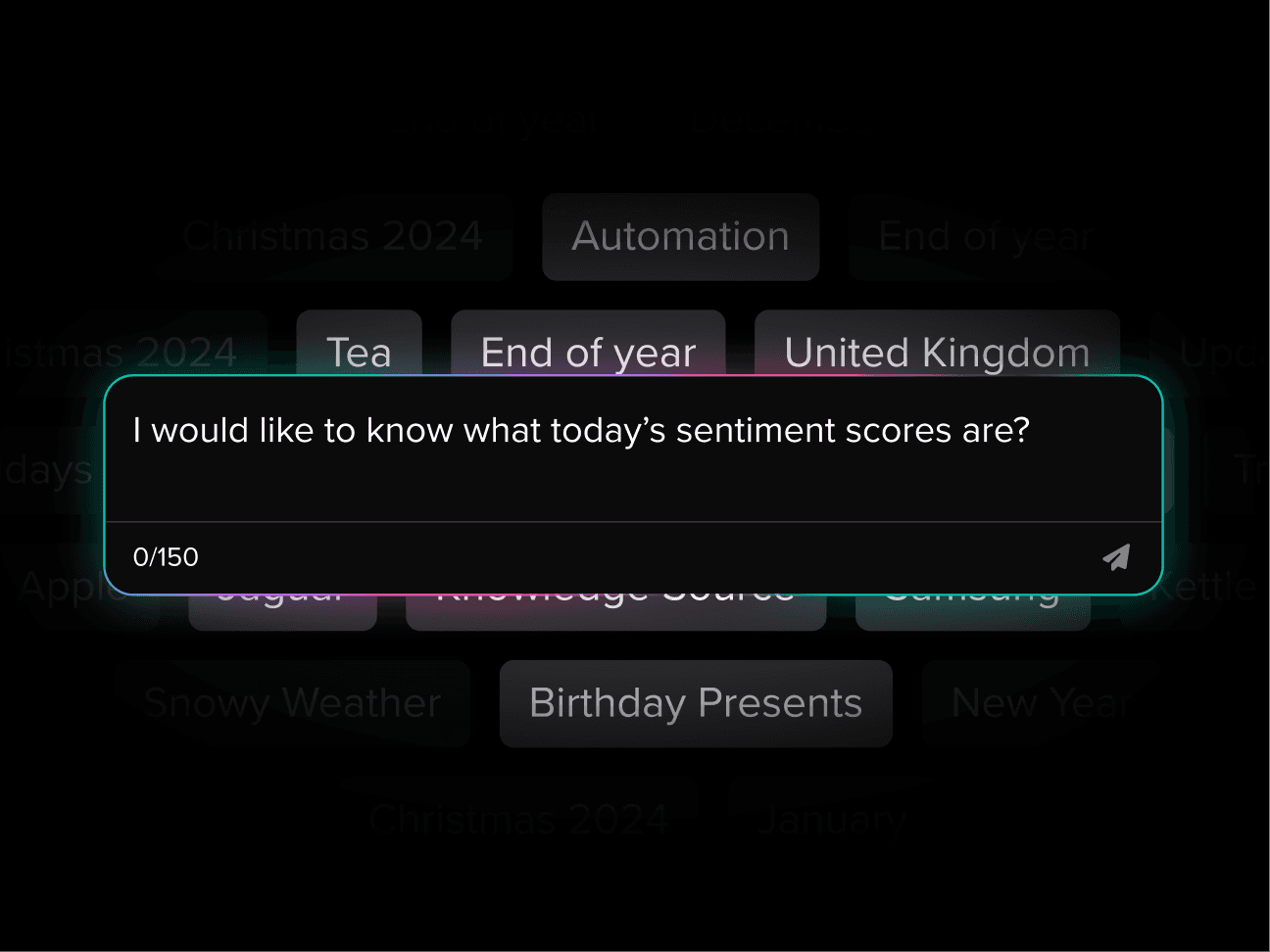
AI voice agents generate a continuous stream of structured interaction and customer experience analytics data (transcripts, intent classifications, resolution outcomes, sentiment signals, and escalation events) that manual call monitoring can only sample. When that data is fed into a real-time AI call analytics layer, it enables a qualitatively different approach to AI quality assurance: rather than reviewing a sample of calls after the fact, operations teams equipped with customer analytics software can monitor all interactions, identify failure patterns as they emerge, and intervene before a problem reaches scale.
ConnexAI's AI analytics capabilities enable it to function as a full contact center analytics platform, allowing managers to track performance across voice agent interactions at the aggregate and individual level, with dashboards that surface resolution rate trends, common escalation triggers, and call sentiment distributions. This closes the customer experience AI feedback loop between deployment and improvement, allowing businesses to refine prompts, update knowledge bases, and reconfigure resolution flows based on observed rather than assumed performance.
Workflow and Back-Office Automation
An AI voice agent becomes far more capable when it can move from conversation into action. By connecting AI voice agents to downstream systems through Agentic AI Orchestration and agentic workflows, a customer request can trigger the right sequence of tasks automatically. For example, if a customer asks to cancel an order, the agent can verify the request, update the order management system, trigger the cancellation, and confirm the outcome during the same call.
This combination of conversational AI, system actions, and multi-step agentic workflows allows voice agents to handle more complex queries end-to-end, rather than simply answering questions or passing tasks to human teams.
Gartner predicts that agentic AI will autonomously resolve 80% of common customer service issues without human intervention by 2029, with an associated 30% reduction in operational costs. That projection is predicated not just on better AI conversation: it requires AI that can take action, not just talk about it.

In What Industries Are AI Voice Agents Delivering Proven Results?
AI voice agents have moved well beyond pilot programmes in several industries. In each case, the operational challenge is specific, the customer service AI solution is tailored, and the outcomes are measurable. Here is what deployment looks like across the sectors where the evidence is strongest.
Financial Services
The challenge in financial services contact centres is volume combined with complexity. High-frequency, low-complexity calls like balance enquiries, transaction disputes, card activation, or fraud alerts sit alongside high-stakes, regulated conversations about mortgages, insurance, and investment products. The risk of mishandling either type is significant, and the cost of overstaffing to handle peak volumes is substantial.
AI voice agents in banking and insurance are being deployed primarily to handle the high-frequency end of this spectrum, with a particular focus on authentication, which, as discussed earlier, consumes a disproportionate share of average handle time. McKinsey's case study of a leading bank found that approximately 20% of contact centre requests had their wait times eliminated within seven weeks of deploying a generative AI customer-facing system. That result, in one of the world's most heavily regulated sectors, demonstrates that the compliance challenges in financial services, while real, are navigable.
Healthcare
Healthcare contact centres face a distinctive pressure: call volume is often driven by patient anxiety rather than transactional need. A patient calling about medical bills, affordable care, or financial assistance is often dealing with a stressful situation, making the design of an AI phone agent particularly nuanced.
A useful example is CareGuide, a US healthcare cost advocacy service that helps patients navigate medical bills, negotiate charges, find affordable care, and secure financial assistance. Its patients contact the organisation around the clock, across multiple languages, creating a strong use case for AI voice that can provide immediate support while human advocates focus on more complex cases. CareGuide uses specialised ConnexAI AI Agents across different roles, with AI Voice enabling patients to communicate with them over the phone. CEO Bill Richmond describes the calls as “human, lifelike”, adding that they are “authentic, empathetic, and fully adjustable.” CareGuide also uses automatic language detection to switch between languages, helping it support a diverse patient population.

Utilities and Energy
Utility contact centres are among the most volume-pressured environments in any sector, with spikes driven by billing cycles, outage events, and regulatory price changes. A single billing cycle in a mid-sized utility can generate tens of thousands of near-identical inbound enquiries ("why has my bill gone up?", "what does this charge mean?", "when is my payment due?") that are time-consuming for human agents but structurally simple to resolve with accurate product knowledge.
AI voice agents configured against a utility's tariff and billing logic can resolve the majority of these enquiries without any human involvement, absorbing the spike that would otherwise require significant seasonal or contingent staffing. When the system is also connected to the billing platform in real time, so that it can give the customer their actual balance, actual payment date, and actual tariff, resolution rates rise and escalation rates fall. The business case in utilities is among the clearest and most replicable of any sector.
Telecommunications
Telecom businesses operate contact centres at a scale that few other industries match, and they face a particularly acute version of the churn problem: a customer calling to cancel a service is also, by definition, a customer who might be retained if the conversation goes well. AI voice agents in telecoms are being deployed for two distinct purposes: handling routine service queries (billing, usage, technical fault reporting) and, more recently, supporting retention conversations by surfacing personalised offers in real time during a call.
The latter application represents a more sophisticated use of the technology, one where the AI voice agent is connected not just to the customer's account data but to a real-time propensity model that determines which retention offer is most likely to succeed based on the customer's profile and call context. This is a use case that benefits directly from the CRM and analytics integrations described earlier.
Retail and E-Commerce
For retailers and e-commerce businesses, the post-purchase period is where contact centre volume concentrates. Order tracking, delivery issues, returns, and refunds account for the majority of inbound contacts, particularly in the peak trading periods that matter most for profitability. These enquiries are, in aggregate, among the most automatable in any sector: they are information-centric, they have defined resolution paths, and they can be resolved against structured data (order systems, carrier APIs) without any ambiguity.
AI voice agents that integrate directly with order management and carrier tracking systems can resolve the majority of post-purchase enquiries end-to-end, giving the customer their delivery status, initiating a return, or processing a refund without requiring human agent involvement. During peak periods, this automation acts as a relief valve that prevents the queue from becoming unmanageable and avoids the cost of temporary staffing at exactly the point where margins are under the most pressure.
Business Process Outsourcing (BPO)
BPO providers face a structural challenge that AI voice agents address particularly directly: they are contracted to deliver a defined service level at a defined cost, and any technology that improves agent productivity without reducing service quality directly improves margin. With 30–45% productivity gains documented in customer care functions by McKinsey, the financial case for BPO adoption is compelling.
The additional consideration for BPO providers is competitive: as more enterprise clients expect AI-augmented service delivery as standard, BPOs that cannot demonstrate a credible AI voice capability risk being displaced by those that can. For BPO operators, AI voice agent deployment is therefore simultaneously a margin improvement opportunity and a commercial differentiation strategy.
How are AI voice agents used in financial services?
Can AI voice agents be used in healthcare?
Can AI voice agents handle retail and e-commerce enquiries?
How can telecom companies use AI voice agents?
Why are utilities a good use case for AI voice agents?
How to Implement an AI Voice Agent: A Practical Guide
Deploying an AI voice agent is the beginning of an ongoing process. The strongest outcomes come from treating customer service AI implementation as a structured programme rather than a technology installation.
Step 1: Define the Scope by Call Type, Not Volume
Start by identifying which call types are suited to AI voice automation, rather than asking what percentage of total calls could be automated.
Conduct a call audit covering intent, complexity, resolution path, and current resolution rate. Use this to identify two to four high-volume call types with clear resolution paths for the initial deployment, then expand as performance improves.
Step 2: Align Stakeholders Before You Procure
AI voice projects can fail because of organisational misalignment as much as technical limitations. Involve IT, operations, legal, and HR early, covering integration requirements, escalation processes, data handling, compliance, and changes to agent roles.
Aligning these requirements before vendor selection helps prevent late-stage scope reductions and ensures the deployment works operationally as well as technically.
Step 3: Select a Platform Built for Your Stack
Evaluate platforms across three areas: AI quality, integration compatibility, and configurability. Test AI performance against your actual, more challenging call types rather than relying on vendor demonstrations.
Assess how the platform connects with your CRM, telephony, authentication, and downstream systems, as well as how much control your teams have over conversation design, escalation logic, and knowledge management. ConnexAI supports a range of telephony and CRM environments, with configurable conversation flows that operations teams can manage without deep technical dependencies.
Step 4: Build the Knowledge Base and Escalation Design First
AI performance depends on the quality of the knowledge it can access. Audit and structure FAQs, policies, product information, and agent guides so the AI can retrieve accurate, relevant information. Platforms such as ConnexAI’s AI Knowledge can centralise and continuously update this information.
Define escalation logic at the same time, including when calls should reach a human and what context is transferred. A warm handover with the conversation summary, customer context, and suggested next action is more useful than a simple transfer.
Step 5: Pilot with Clear Success Metrics
Run the agent on a defined portion of live traffic with success metrics agreed in advance. Key measures include containment rate, response accuracy, escalation quality, and customer satisfaction.
Use the pilot to identify failure modes rather than demonstrate best-case performance, then address those issues before scaling.
Step 6: Improve Continuously Using Interaction Data
AI voice agents require ongoing optimisation as products, policies, and customer needs change. ConnexAI’s AI analytics provides interaction data such as intent patterns, escalation triggers, resolution trends, and sentiment signals.
Review these regularly to identify underperforming call types and update the knowledge base, conversation design, and escalation logic. The most effective deployments treat AI voice as an ongoing operational capability, not a project with a fixed end date.
How long does it take to implement an AI voice agent?
What should you automate first with an AI voice agent?
What systems does an AI voice agent need to integrate with?
How do you measure the performance of an AI voice agent?
Conclusion: The Time to Build Is Now
The evidence across these chapters is clear: AI voice agents are already being deployed at scale, delivering measurable improvements in productivity, wait times, accuracy, cost, and employee experience. As contact centre demand grows, the gap between businesses deploying AI and those still exploring it is widening.
McKinsey's research shows that 57% of customer care leaders expect call volumes to increase by up to 20%, while hiring remains challenging. AI voice agents offer a scalable way to absorb this demand without relying solely on headcount.
Getting implementation right remains critical. Poor escalation paths, outdated knowledge bases, or unsuitable use cases can undermine results, which is why Chapter 8 emphasises structure before technology, scope before scale, and iteration before optimisation.
For most businesses, the logical starting point is the call audit in Step 1: analysing inbound interactions to identify which call types are genuinely suited to automation. From there, businesses can shape vendor selection, stakeholder alignment, pilot design, and success metrics.
ConnexAI supports businesses from initial exploration through to full deployment, integrating with existing telephony and CRM environments. If you want to understand what AI voice agents could deliver in terms of containment, handle time, and cost per contact, book a demo with the ConnexAI team to explore a deployment built around your operation.
Sources
57% of customer care leaders expect call volumes to increase by up to 20% (McKinsey)
Labour accounts for up to 95% of total contact centre operational costs (Gartner)
14% increase in issue resolution per hour with generative AI assistance (McKinsey)
9% reduction in average handle time with generative AI (McKinsey)
30–45% productivity gain in customer care from generative AI (McKinsey)
$80 billion in projected contact centre labour cost savings from conversational AI by 2026 (Gartner)
88% of organisations use AI in at least one business function in 2025 (McKinsey)