
Introduction
Healthcare providers face a persistent and costly challenge. In outpatient settings, appointment no-show rates range from 23% to 33%, meaning the average medical group can expect roughly 80 established patients and 43 new patients to miss their appointments each month. These missed visits are more than just empty time slots. They cost the U.S. healthcare system an estimated $150 billion annually while disrupting continuity of care, delaying diagnoses, and worsening outcomes for patients with chronic conditions.
The issue extends well beyond no-shows. Recent data shows that 69% of healthcare consumers are now likely to switch providers due to poor communication, up sharply from 51% in 2023. At the same time, 76% of Americans report not having had a positive healthcare experience in the past three months, with inadequate proactive communication cited as a primary driver. For healthcare organizations already strained by staffing shortages and administrative overload, delivering consistent, systematic outbound patient communication has become increasingly unmanageable.
Agentic AI removes this bottleneck. By deploying AI agents, healthcare providers can deliver proactive patient engagement at scale, ensuring timely appointment reminders, test result notifications, follow-up instructions, and preventive care prompts for every patient, regardless of how stretched clinical staff may be by direct patient care.
Understanding AI Agents in Healthcare Outbound Communication
Proactive outbound communication is what sets exceptional healthcare organizations apart from those that simply react to patient needs. Yet traditional outbound processes run into a hard limit: time. Clinicians spend nearly 28 hours per week on administrative duties, and medical office staff devote 34 hours per week to similar tasks, leaving little room for consistent, systematic patient engagement. AI agents remove this barrier, enabling healthcare teams to deliver timely, personalized, and professional communication at scale, without adding to staff workloads.
How AI Agents Enable Proactive Engagement
AI agents can monitor your electronic health record system and practice management software continuously, identifying situations requiring outbound contact based on appointment schedules, test results availability, prescription refill requirements, preventive care timelines, chronic disease management protocols, and post-discharge follow-up needs. When action is required, the AI Agent:
Initiates contact across the patient's preferred channelDelivers personalised information based on their specific health circumstancesResponds to questions and completes related transactionsUpdates your systems with interaction outcomesEscalates to your clinical team only when human intervention is genuinely required
Implementation in Healthcare
AI agents seamlessly integrate with your existing technology infrastructure to automate outbound communication workflows that currently consume significant staff time or are often skipped due to capacity limits. The system learns your specific communication requirements, including HIPAA compliance, clinical protocols, appointment reminder schedules, and patient consent management, and can begin running proactive outbound campaigns immediately. Meanwhile, your team retains full oversight and can focus on complex clinical consultations while the AI agent handles the volume of routine notifications and updates.
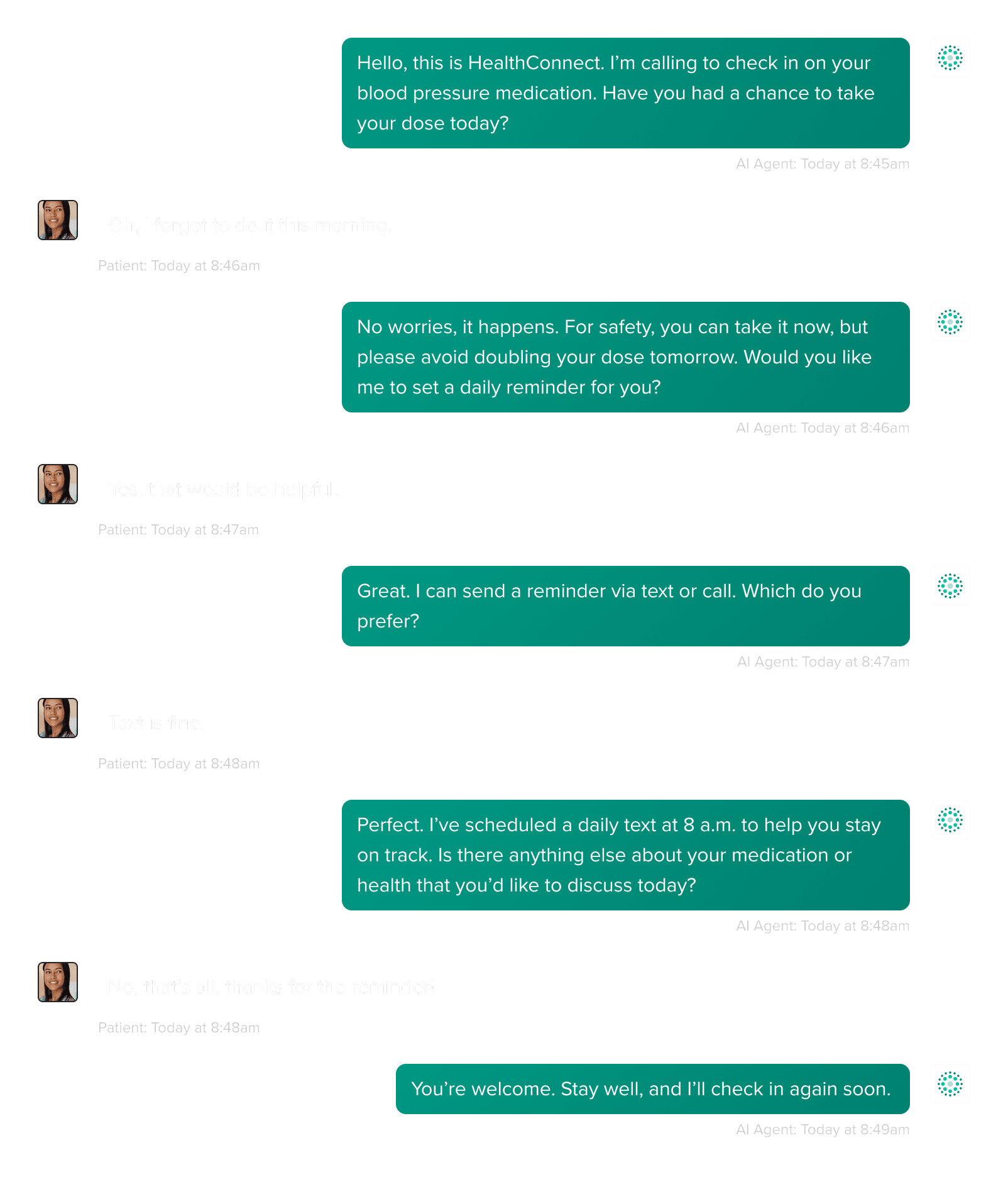
Agentic outbound communication: An example conversation between a customer and a healthcare services AI Agent.
Use Case: Appointment Reminder and Preparation
Scenario:
A patient has a specialist appointment scheduled in three days. Traditional appointment reminder processes rely on either automated text messages with no engagement capability or staff phone calls that consume significant administrative time and often reach voicemail.
Traditional Process Challenges:
Appointment reminders can cut missed appointments and increase clinic attendance when systematically implemented, yet most practices struggle to deliver them consistently. Staff members tasked with reminder calls can't keep up with competing priorities, leaving outreach incomplete, while automated systems send one-way messages that cannot answer questions or facilitate rescheduling. AI agents unlock this missed potential by combining the reliability of automation with conversational intelligence that addresses patient needs in real-time.
AI Agent Solution – Step-by-Step
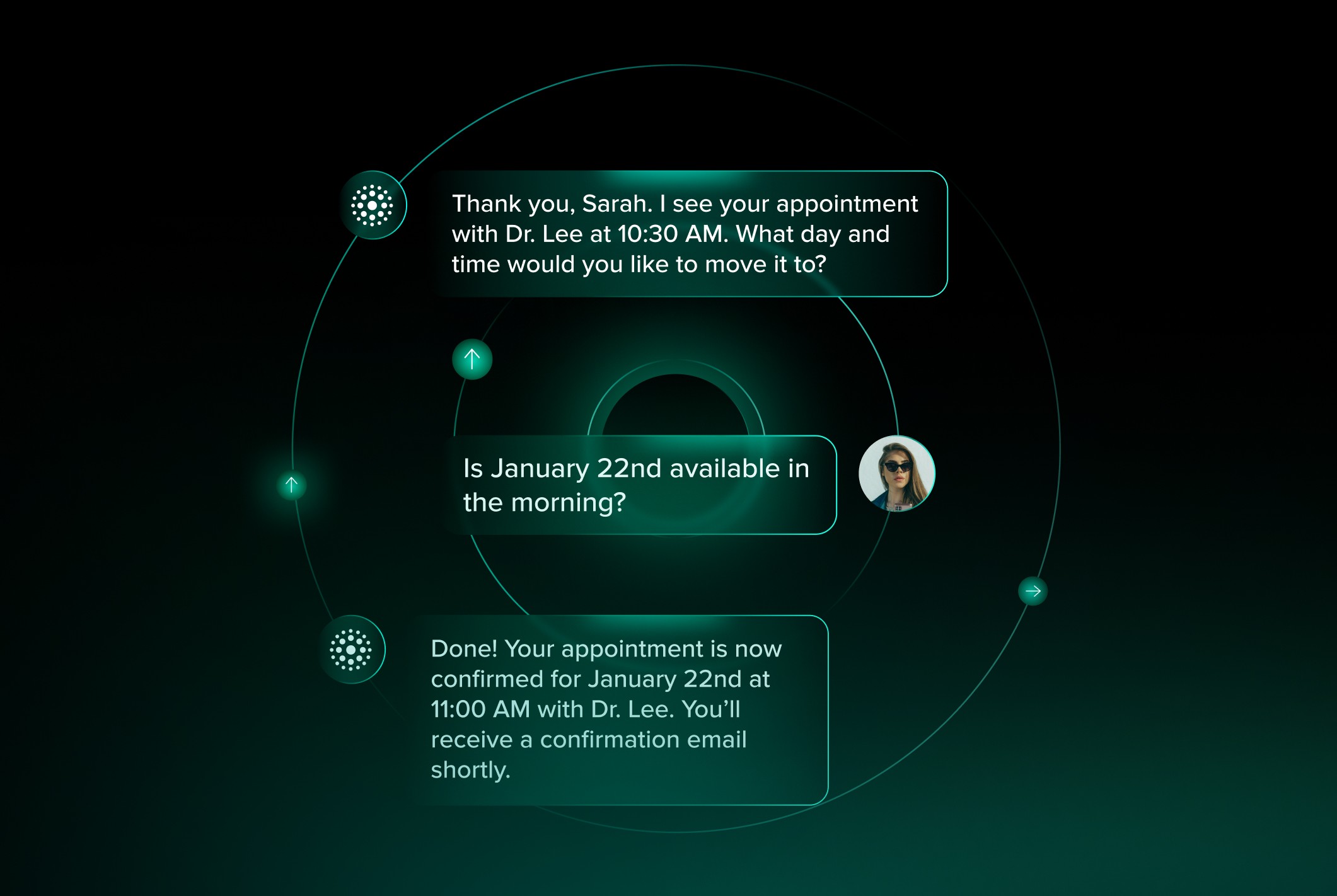
Trigger Identification:The AI agent monitors your practice management system and identifies that a patient has a cardiology consultation scheduled in 72 hours, triggering the reminder protocol.Record Review:The agent accesses the complete patient record to gather relevant context including appointment type, required preparation instructions, previous appointment history, outstanding lab results needed for the consultation, and insurance verification status.Contact Initiation:The agent reaches out via the patient's preferred channel (text message in this case) with a personalized message: "Hello Sarah, this is a reminder about your cardiology consultation with Dr. Chen on Thursday at 2:30 PM. To ensure your appointment is productive, please bring your current medication list and your most recent blood pressure readings."Information Delivery:The agent provides specific pre-appointment instructions, explains what to expect during the consultation, confirms the location with parking information, and checks whether the patient has any questions about preparation.Query Management:The patient responds asking whether they need to fast before the appointment. The agent accesses the appointment type database and relevant clinical protocols to provide an accurate response: "No fasting is required for your consultation. However, please take your morning medications as prescribed and bring a list of all current medications including dosages."Transaction Completion:The patient asks to reschedule to the following week due to a work conflict. The agent accesses Dr. Chen's schedule, offers three available alternative times, receives the patient's selection, updates the practice management system, cancels the original appointment, books the new appointment, and sends confirmation of the rescheduled visit—all within the same conversation thread.Clinical Protocol Verification:The agent verifies that the patient has signed current HIPAA authorizations for electronic communication, confirms the patient's insurance remains active for the appointment date, and checks whether any required prior authorizations are in place.EHR Update:The agent logs the complete interaction including the patient's acknowledgement of the reminder, rescheduling transaction details, questions addressed, and confirmation of preparation instructions, creating visibility for clinical staff.Follow-Up Scheduling:Based on the interaction outcome, the agent schedules a final reminder 24 hours before the new appointment date and sets a flag for staff follow-up if the patient fails to check in on the appointment date, ensuring continued engagement and preventing missed appointments.
Beyond Single Notifications: Broader AI Agent Capabilities
AI agents deliver value across the complete spectrum of healthcare outbound communication requirements:
Preventive Care Outreach:AI agents identify patients due for annual physical examinations, cancer screenings, vaccinations, and chronic disease monitoring appointments. Rather than waiting for patients to remember or initiating labour-intensive staff calling campaigns, the agent proactively contacts each patient, explains what preventive services they need, facilitates appointment scheduling, and addresses any concerns about the recommended care.Test Results Notification:When laboratory results, imaging studies, or diagnostic test results become available, AI agents notify patients promptly through their preferred communication channel. The agent can provide normal results directly, explain what the findings mean in accessible language, address common questions about the results, and schedule necessary follow-up appointments with clinical staff for abnormal findings requiring discussion.Medication Management:AI agents monitor prescription refill cycles and proactively contact patients approaching the end of their medication supply. The agent can process straightforward refill requests, coordinate with pharmacy systems to ensure medications are ready for collection, address adherence barriers patients may be experiencing, and escalate to clinical staff when medication reviews or adjustments may be needed.Chronic Disease Management:For patients with diabetes, hypertension, heart disease, or other chronic conditions requiring regular monitoring, AI agents deliver systematic outreach that supports treatment adherence. The agent can send medication reminders, collect patient-reported symptoms or measurements like blood glucose readings, provide encouragement and education about disease management, identify concerning trends requiring clinical intervention, and ensure patients attend necessary monitoring appointments.Post-Discharge Follow-Up:Following hospital discharge, AI agents contact patients to verify they understand their discharge instructions, confirm they have collected prescribed medications, assess whether they're experiencing any concerning symptoms, ensure they've scheduled required follow-up appointments, and address questions about wound care, activity restrictions, or medication regimens—critical outreach that reduces readmission rates but often doesn't occur consistently due to staff capacity constraints.
The technology transforms outbound communication from an aspirational goal to a systematic operational capability. Healthcare providers can now contact every patient due for a wellness visit rather than only those who happen to book appointments. Practices can provide appointment reminders with two-way communication capability to every scheduled patient, not just those staff have time to call. Chronic disease patients can receive consistent monitoring check-ins that support treatment adherence. Every surgical patient can receive post-operative care instructions and symptom monitoring regardless of surgical volume.
This systematic approach to proactive engagement directly addresses a primary source of patient dissatisfaction in healthcare: feeling neglected or uninformed between appointments. AI agents ensure every patient receives consistent, timely outbound communication regardless of how busy clinical and administrative staff are with direct patient care and urgent matters.
Real-World Impact: Multi-Specialty Practice Success
Real-World Impact: Healthcare Cost Advocacy Success
CareGuide, a US-based healthcare cost advocacy service, implemented ConnexAI's agentic AI solution to transform their patient communication and support operations. The company faced significant challenges: patients reaching out at all hours across multiple channels and languages during emotionally charged moments, increasing pressure on advocates to maintain empathetic responses, and the inability to provide consistent 24/7 coverage without overburdening staff.
Results
Patient interaction coverage achieved 100%, reducing missed inbound communications to zero as AI agents provide round-the-clock support.
Data capture improved by 10-12%, providing advocates with richer information to support their work helping patients navigate medical billing and secure financial assistance.
Patient savings nearly doubled in the first 10 months of 2025 compared to all of 2024.
The platform's omnichannel capabilities and centralized data repository enable proactive patient outreach for timely follow-ups on pending bill negotiations, status updates on financial assistance applications, and educational communication about available savings programmes.
The Care Advocate team now concentrates on complex negotiations and high-touch interventions whilst multiple specialized AI agents handle both incoming patient inquiries and systematic outreach, along with bilingual support and omnichannel communication continuity. As CEO Bill Richmond observed: "While my team is sleeping so they can get up the next day and help save on hospital bills, we have ConnexAI working 24/7 to be able to ingest customer questions. It's no longer a learning curve; it's a learning rocket."
Conclusion
Healthcare organizations that are building strong competitive positions today are those adopting systematic, proactive outbound patient communication. While many competitors remain limited to reactive approaches due to resource constraints, forward-thinking practices leverage AI agents to deliver consistent, proactive engagement at scale, driving significantly higher patient retention through timely and responsive communication.
Traditional outbound processes face a simple mathematical limitation: teams can only make so many calls, send so many reminders, and conduct so many follow-ups each day. This is especially challenging when clinicians spend 28 hours per week on administrative duties and office staff dedicate 34 hours weekly to similar tasks. AI agents remove this limitation while preserving the personalized and professional communication patients expect. They allow practices to systematically remind patients of appointments, reduce missed visits through reliable two-way communication that enables easy rescheduling, and ensure every patient receives necessary follow-up regardless of staff workload.
For healthcare organizations aiming to enhance patient satisfaction through proactive service, protect revenue from missed appointments, differentiate through superior communication, and reduce the burden of inbound follow-up calls, AI agents turn outbound communication from a resource-constrained task into a clear competitive advantage. With 69% of healthcare consumers now likely to switch providers due to poor communication, up sharply from 51% in 2023, organizations that implement systematic, AI-powered outbound engagement today will capture and retain the patients that competitors lose tomorrow.
Kickstart Your AI Journey
Discover how ConnexAI’s agentic AI platform can transform outbound healthcare operations, from patient outreach to care coordination and follow-ups.
Request a demo of our Healthcare AI technology: connex.ai/contact-us
Learn more about our Agentic AI solutions for healthcare providers: connex.ai/solutions/healthcare
FAQs
Do you want to know more about how AI agents can reduce missed appointments, engage patients proactively, and streamline communication? This FAQ answers the top questions on using AI to keep patients informed, satisfied, and connected to your care teams.
How is an AI agent different from traditional healthcare automation tools or chatbots?
Can AI agents safely operate without increasing clinical risk?
How do AI agents maintain empathy and trust in patient communication?
What is the impact on patient retention and lifetime value?
How quickly can healthcare organizations see measurable results?
Sources
Missed Appointment Volume (80 established and 43 new patients monthly per medical group)
No-Show Financial Impact ($150 billion annual cost to US healthcare)
Provider Switching Due to Poor Communication (69%, up from 51% in 2023)
Patient Experience Survey (76% report no positive healthcare experience in past three months)
Medical Office Staff Administrative Tasks (34 hours per week)
Reminder System Effectiveness (41% reduction in missed appointments, 34% attendance increase)
Patient Channel Preferences (69% prefer phone for scheduling, 32% for general contact)
Communication and Provider Switching (nearly half would switch if needs unmet)
No-Show Rate Trends (58% report 2024 rates consistent with 2023)